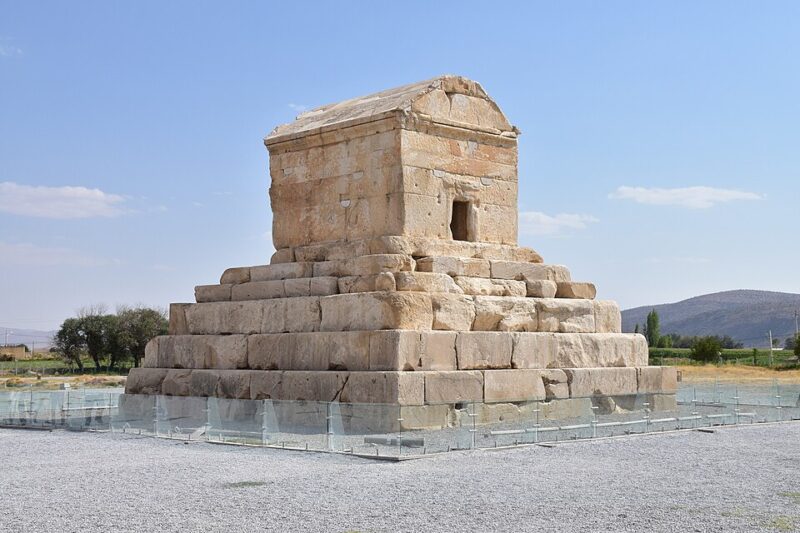
On 22 April 2026, in a ceremony draped in the grammar of legality, Iranian officials formally handed over the title deed of Golestan Palace and symbolically delivered four more deeds for Hegmataneh, Pasargadae, Persepolis, and Chehel Sotoun to the Minister of Cultural Heritage, Tourism and Handicrafts. In the official script, this was presented as a triumph of order: the nation’s treasures, now safely papered, stamped, and tucked beneath the wing of the state.
But a deed is not a moral argument. A registry office is not a sanctuary. And a government that places its seal on a monument does not thereby acquire the right to speak as civilization’s trustee.
There is a necessary factual distinction here, because accuracy matters most when the language of authority begins to preen. UNESCO does not forbid state ownership of World Heritage sites. In fact, UNESCO explicitly states that a World Heritage property remains the property of the country in whose territory it lies. Its protection, however, becomes a matter of concern to the international community as a whole. In the Iranian case, UNESCO’s own pages already describe Persepolis and Pasargadae as properties owned by the Government of Iran, and Golestan Palace as having been transferred into government ownership under Iranian law decades ago. In other words, the ceremony did not create a miraculous new principle of protection. It staged a political spectacle around powers the state already substantially possessed.
That is precisely why this news is so chilling. The scandal is not that a state can own heritage. Many states do. The scandal is what it means when a deeply coercive state, in the middle of national trauma, performs ownership as though heritage were an asset class, a fenced parcel, a decorative clause in the paperwork of domination. This is not the calm administration of stewardship. It is the state arriving at the ruins with a fresh folder and calling that care.
The timing matters. It matters obscenely. The transfer comes while Iran has been living through a communications blackout so severe that monitors have described it as the longest and most comprehensive shutdown in the history of the Islamic Republic, with NetBlocks reporting in April that the shutdown had entered its 52nd day and that ordinary users remained cut off from international networks while selective access was being restored to favored groups. Darkness, it seems, is now a management strategy. First mute the witnesses, then tidy the files.
And this legal theatre unfolds against a far bloodier stage. The UN Fact-Finding Mission on Iran has described the recent repression as what appears to be the deadliest crackdown against the Iranian people since 1979, with credible reports that thousands were killed and more than 24,000 people arrested. Amnesty International has said verified videos and eyewitness testimony show mass unlawful killings on an unprecedented scale amid an internet shutdown imposed to conceal the crimes. Human Rights Watch has likewise reported mass killings, severe communications restrictions, and evidence suggesting large-scale atrocities whose full dimensions remain obscured.
So let us be frank about the obscenity of the image. A state stands accused by international human rights bodies and rights organizations of arbitrary killings, mass arrests, torture, and possible crimes against humanity, while simultaneously presenting itself as the proper legal guardian of Persepolis. The choreography is almost too neat: blood on the street, velvet on the lectern, a heritage deed held up like a clean white glove.
And yet the deeper insult is intellectual. Heritage is not merely stone under custody. It is trust, continuity, access, interpretation, scholarly freedom, and public memory. The ethical language of museum and heritage work has said this for years. ICOM’s Code of Ethics describes integrity, responsibility, transparency, and accountability as essential to museums serving society. ICOM’s own statement on museum independence says museums should maintain control over the content and integrity of their programs regardless of funding source or governance model, and that their autonomy should not be jeopardized by political interests. By those standards, the question is not whether a ministry can hold title. The question is whether institutions can function ethically when power behaves like a burglar wearing an archivist’s gloves.
The international guardians, for their part, have not been entirely silent. UNESCO expressed concern in March after damage to Golestan Palace and said it had shared the geographic coordinates of World Heritage and nationally significant sites with all parties to the conflict. ICOM issued a statement of concern over the risks facing museums and cultural heritage in Iran and the broader region. Blue Shield said it was monitoring the status of sites and stood ready to assist. ICOMOS reiterated its concern, condemned destruction of heritage, and reminded all parties of their obligations under the 1954 Hague Convention and related legal frameworks.
But concern is not protection. Monitoring is not intervention. A reminder of treaty law is not the same thing as a mechanism capable of stopping either bombs or bureaucrats. The public record, so far, is full of verbs like monitor, recall, express concern, stand ready. These are honorable verbs in a press office. They are thinner things beside shattered windows, censored networks, terrified staff, and a state apparatus tightening its grip on both the narrative and the paperwork. Iranian heritage professionals have already called for urgent international monitoring, documentation, and safeguarding, explicitly warning that conflict and restricted communication are leaving museums and sites dangerously exposed. They have been asking, in essence, not for poetry, but for witnesses.
This is where the deed ceremony becomes more than provincial legalism. It is a claim about who gets to narrate Iranian civilization. It says: we are the owner, therefore we are the voice. We are the custodian, therefore we are the country. It attempts to reduce a civilization thousands of years deep into a notarized relationship between a ministry and a monument. The state, having failed to protect life, now reaches for title over memory.
But Persepolis does not belong to the office that files it. Golestan does not become morally legible because a judiciary printer emitted a page. Pasargadae is not a bureaucratic inheritance. Hegmataneh is not redeemed by cadastral tidiness. Chehel Sotoun is not safer because the hand that clutches the deed can also throttle the witness.
If there is a lawful and ethical understanding of ownership worthy of these places, it is this: they belong first to the historical life of Iran, to the people who have studied them, cared for them, mourned them, repaired them, taught them, and fought to keep them from erasure. And because several of them are also inscribed as World Heritage, they belong in another sense to the world’s shared responsibility, which is supposed to begin where sovereignty fails, not bow politely before it.
The deed, then, is not the story. The story is that, amid blackout and bereavement, a state chose to dramatize possession. The story is that international organizations have articulated principles more forcefully than they have enforced them. The story is that Iranian heritage professionals are being asked to preserve civilization while surrounded by censorship, violence, and the administrative vanity of power.
One can almost hear the registrar’s stamp hitting the page: a tiny percussion section for a tragedy already in progress.