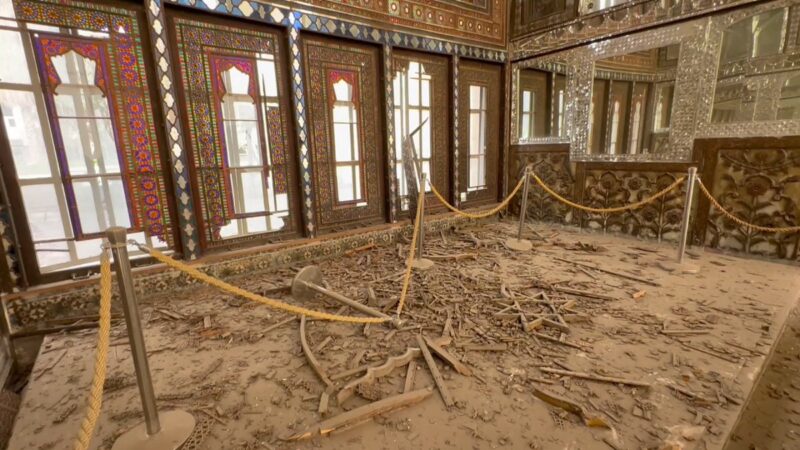
War likes an entrance. It arrives with blast and plume, with the vulgar confidence of a brute kicking through a painted door. But in Iran, the war did not enter a well-kept house. It entered a house the state had already been quietly dismantling room by room, cornice by cornice, dome by dome, file by file. The bombs supplied the thunder. The regime had long been arranging the collapse.
Over the past several weeks, the official count of damaged heritage sites in Iran has continued to climb. UNESCO has confirmed damage to some of the country’s most symbolically charged landmarks, including Golestan Palace in Tehran, Chehel Sotoun in Isfahan, the Jame Mosque of Isfahan, and buildings near the prehistoric sites of the Khorramabad Valley. At Golestan, mirrored ceilings shed glass like broken frost. At Chehel Sotoun, carved details and windows were damaged. The repertoire of injury is by now familiar: shattered surfaces, fractured ornament, splintered memory.
But let us not lend the Islamic Republic the cheap dignity of surprise. The regime would now like to stand in the rubble draped in the vocabulary of guardianship, speaking gravely of civilization while brushing dust from the cuffs of its own long record. It does not deserve that costume. These monuments were not struck in a condition of careful stewardship. They were struck after years of attrition under a government that has treated cultural heritage not as an inheritance to protect but as a nuisance to manage, a revenue stream to brand, a propaganda backdrop to stage, or an obstacle to bulldoze when power, vanity, ideology, or real-estate appetite required it.
This is not “clumsiness.” Clumsiness spills tea. Clumsiness drops a tray. What we have watched for years in Iran is something harsher and more deliberate: bureaucratized vandalism, institutionalized neglect, and administrative violence against the material past. The damage has often arrived not with a missile but with a permit, a revised boundary, a delayed budget, a cynical restoration contract, a conveniently weak objection, a strategic silence. The state has not merely failed to protect heritage. It has repeatedly collaborated in its exhaustion.
Even Iranian reporting has made plain how skeletal the protection system has become. One recent Payam-e Ma report, drawing on expert criticism and parliamentary research, noted that only 3% of the 2019 law for protecting historic urban fabric had been implemented. The same discussion pointed to the absurd mismatch between the scale of Iran’s historic built environment and the tiny proportion formally registered or adequately protected. Elsewhere, state media have themselves published figures so meager they read like satire: roughly 13 million tomans (approximately $164) per historic building and only 900,000 tomans (approximately $12) per archaeological site for protection, maintenance, and restoration. This is not preservation policy. It is an alibi with a budget line.
And then there are the restorations that arrive like second assaults. Sedaye Miras documented the condition of the dome of the Imam Mosque in Isfahan before restoration as already critically cracked and at risk, while the broader controversy around the mosque’s restoration became a public lesson in how official intervention can deform what time had not yet managed to destroy. The regime has cultivated a peculiar expertise in this field: wounding a monument and then appearing beside it in a hard hat.
So when war damage now spreads across Iran’s historic landscape, what we are seeing is not the sudden fall of an intact order. It is an acceleration. The missiles did not invent vulnerability. They found it waiting for them. They found monuments already weakened by subsidence, underfunding, legal dilution, incompetent intervention, and development schemes dressed up as necessity. The state had spent years loosening the bolts, and now wishes to be applauded for gasping as the chandelier falls.
And over this entire scene, the regime has drawn its preferred curtain: darkness. By 18 April, NetBlocks reported that Iran had entered its 50th day of isolation from the global internet, an unprecedented blackout for a connected society. Amnesty International had already warned in January that the authorities were using the shutdown to hide grave abuses during their deadly crackdown on protesters. Human Rights Watch said much the same. In other words, the blackout is not some unfortunate technical side effect of crisis. It is a governing method. It is how evidence is suffocated. It is how states try to turn atrocity into rumor and damage into administrative weather.
For heritage, this matters enormously. A cracked iwan in a darkened city is not merely damaged. It is made harder to witness, harder to verify, harder to archive, harder to defend. The internet shutdown is therefore not adjacent to the story of cultural destruction. It is one of its central instruments. If a regime can throttle images, delay testimony, isolate curators, and muddy timelines, it can manage the public afterlife of the ruin even when it cannot prevent the ruin itself. The blackout does not repair a broken monument. It simply breaks the chain of seeing.
Nor can the danger to culture workers be politely separated from the danger to everyone else. Monuments do not mourn themselves. Archives do not evacuate themselves. Museum staff, site guards, conservators, archaeologists, photographers, and local custodians have all been forced to work under the pressure of war, repression, and communications blackout. Meanwhile, international human rights groups have documented lethal state violence against protesters since January, with the blackout itself used to conceal abuses. When a government can slaughter citizens in the dark and choke the signal while doing so, it also places every cultural worker in a field of fear. A threatened society does not somehow produce unthreatened custodians.
International organizations, meanwhile, have perfected the art of the lowered voice. UNESCO has expressed concern and verified damage. ICOMOS has acknowledged the devastating human consequences of the conflict and the implications for cultural continuity. Fine. Correct. Necessary. But one begins to suspect that for certain institutions, outrage must pass through so many filters that it emerges as upholstery. Their language arrives pressed, careful, and bloodless, even when the ceilings are broken, the dead are uncounted, the curators endangered, and the evidence throttled by a blackout now stretching nearly fifty days.
The recent statement reported by The Art Newspaper, signed by more than 200 scholars and cultural professionals, is welcome insofar as it condemns the wartime destruction and the feebleness of the international response. But it also leaves a question hanging in the air like smoke in a damaged hall: where, exactly, were these voices while the Iranian state spent years grinding away at the country’s heritage through corruption, underfunding, predatory development, incompetent restoration, and plain administrative abuse? Had these same signatories, individually or collectively, raised comparable public alarm when the regime was chewing through historic fabric in slower motion? Had they protested the attrition before the blast wave made it fashionable? The article does not say. That silence matters.
And the question sharpens further when one recalls the much larger silence surrounding the regime’s slaughter of Iranians themselves. Cultural heritage does not float above political life like a chandelier in a sealed ballroom. It is bound to the living society beneath it. When tens of thousands of people are killed, disappeared, terrorized, or driven into peril, culture workers are not exempt from the machinery of fear. International organizations that speak with exquisite caution about damaged palaces, yet with little moral urgency about dead citizens, endangered archivists, and terrorized communities, are not defending culture in full. They are defending its shell while averting their eyes from the people who give it breath.
So let us be plain. Yes, the recent strikes on Iran’s heritage sites must be condemned. Unequivocally. But no serious account of this destruction can permit the Islamic Republic to audition as tragic custodian. This state has spent years degrading the legal, financial, and professional conditions required for preservation. It has starved monuments, weakened protections, mangled restorations, tolerated encroachments, obscured evidence, endangered those who care for the past, and then stepped before the cameras in the tone of bereavement. It is not merely incompetent. It is injurious. It has not simply failed the country’s heritage. It has helped prepare it for injury.
The war set fire to the stage. The regime had already been sawing through the floorboards.