
Re|Shaping Policies for Creativity is not another love letter to culture. It is a brisk demand for budgets, rights, metrics, mobility, and fewer grand speeches standing in for actual policy.
The cultural sector has never lacked flattering language. Culture is vital, transformative, inclusive, resilient, regenerative, future-facing, community-building, soul-nourishing. It has been praised from lecterns, embroidered into strategy documents, and wheeled out whenever a city wants to sound civilised.
What it has not always received is infrastructure.
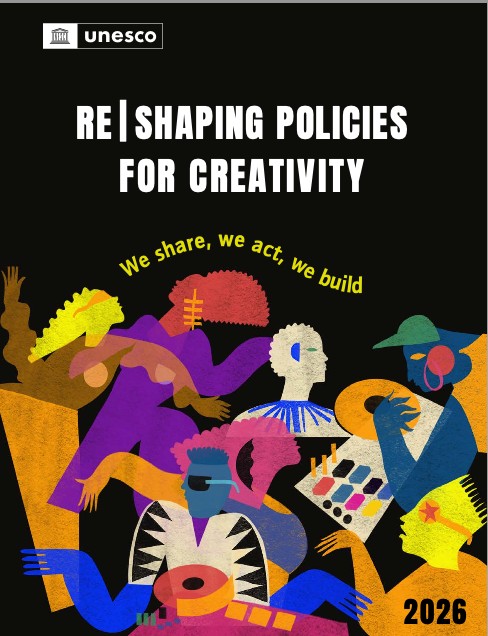
That is what makes UNESCO’s newly published 2026 edition of Re|Shaping Policies for Creativity worth reading. It is not especially interested in serenading culture. It assumes culture matters and moves briskly on to the harder question: are governments and institutions building the conditions in which creative life can actually function?
That means money, naturally. It also means targets, trade, mobility, rights, digital capacity, safer working conditions, and protection for artistic freedom. In other words, all the stubbornly unglamorous machinery without which cultural rhetoric collapses like a cardboard palace in the rain.
For museums, galleries, festivals, ministries, and everyone else routinely asked to “do more with less”, this is where the report earns its keep. It is not another mood board for the global culture class. It is a ledger.
Culture is in the strategy. It is not always in the system.
One of the report’s clearest findings is also one of the most revealing. Eighty-five percent of surveyed countries now integrate cultural and creative industries into national development plans. Lovely. Culture has made it into the official family portrait.
But then comes the less photogenic detail: only 56% set specific cultural goals. That is the difference between a commitment and a compliment.
Once culture is written into a development plan without measurable objectives, it risks becoming decorative language. It sounds enlightened. It looks good in a PDF. It does not necessarily change how decisions are made, how budgets are allocated, or who is accountable when the fine words drift offstage.
UNESCO’s wider development findings sharpen the point. Ninety-three percent of countries involve cultural agencies in sustainable development planning, and 85% report culture-led regeneration initiatives. Culture is clearly in the room. The problem is that it is too often in the room wearing a corsage rather than carrying a toolkit.
And then there is the money. UNESCO reports that direct public funding for culture remains under 0.6% of GDP globally and continues to decline. Development aid for culture is even thinner, representing 0.15% of total Country Programmable Aid in 2022. That is not a ringing endorsement. It is a polite cough.
The practical lesson is plain enough to be almost rude: stop praising culture in principle and start specifying it in policy. Put it into national and local plans with clear targets. Tie those targets to budget lines. Assign responsibility. Publish progress. Make someone answer for delivery. Culture does not become strategic because a minister says it is. It becomes strategic when failure to support it shows up in the machinery of government.
The digital turn has arrived. The fairness memo is running late.
UNESCO is especially useful on digital culture because it refuses the usual fairy tale. Yes, digital tools have expanded access and opened new routes to audiences. Yes, they have created new markets. No, they have not automatically made the sector fairer.
The report notes that 85% of countries support the digital transformation of the cultural sector, and that 35% of creators’ revenues now come from digital services, up from 17% in 2018. That is no longer an experimental side corridor. It is the building.
But power inside that building is unevenly distributed. UNESCO notes that only 16% of people in developing countries have intermediate ICT skills, compared with 45% in developed countries. It also reports that only 48% of countries have developed statistics on digital cultural content consumption. So we have a cultural economy increasingly shaped by platforms, data, recommendation systems, and digital distribution, while much of policy is still peering at it through opera glasses.
For museums and cultural organisations, this means a digital strategy cannot simply be a slick website, a chirpy social feed, and the annual flirtation with immersive technology. It has to include staff skills, better metadata, rights management, proper contracts, and a clear-eyed understanding of who benefits when culture moves through commercial platforms.
If institutions commission digital work, they should define ownership, licensing, reuse, and revenue terms properly. If they digitise collections, they should think beyond access and into discoverability, context, and rights. If they want to support creators in a platform economy, they need legal literacy as much as curatorial imagination.
Digital culture is not airy and frictionless. It has toll booths.
Mobility is back. Reciprocity is still waiting at the visa desk.
UNESCO reports that 80% of mobility opportunities are once again in person. That matters. Despite occasional fantasies to the contrary, cultural work remains stubbornly embodied. Artists, curators, performers, and scholars often need to be somewhere. Presence is not an indulgence. It is part of the work.
But the report also shows how unequal cultural mobility remains. Ninety-six percent of developed countries support outward mobility, while only 38% facilitate inward mobility from developing nations. That is not quite a global exchange. That is a well-upholstered one-way system.
UNESCO also notes that 56% of developing countries fund South-South mobility. That suggests some of the most serious work in cultural exchange is happening outside the old prestige routes, precisely because those routes remain so selective.
The practical implications for museums and cultural institutions are immediate. Internationalism should not mean issuing an invitation letter and then wishing an artist luck against border bureaucracy. Budget for visa support. Offer administrative help early. Cover actual travel costs. Build partnerships that do not always funnel legitimacy through the same handful of capitals. Use hybrid participation when necessary, but without pretending it is always equivalent.
An institution is not international because its brochure says so. It is international when it removes barriers rather than merely describing them beautifully.
Trade in culture is growing. The value still knows how to slip out the side door.
UNESCO reports that global trade in cultural goods doubled to US$254 billion between 2005 and 2023, and that 46% of exports now come from developing countries. Those are significant shifts. But the report is too sober to mistake movement for justice.
Developing countries still account for only around 20% of global trade in cultural services, though that is up from 12% in 2010. More sharply still, UNESCO notes that only 5% of the global market use of intellectual property is held by developing countries.
There lies the trick. Culture circulates. Value accumulates elsewhere.
Museums, galleries, publishers, and festivals are not innocent bystanders here. They commission, license, publish, digitise, tour, retail, and amplify. They are part of the chain by which cultural value is created and captured. That means they also have levers.
They can improve contract standards. They can stop treating exposure as a substitute for payment, a trick so elderly it deserves a museum case of its own. They can track what they commission, what they pay, what rights are retained, and who benefits when work travels. They can build partnerships that do not depend on endlessly extracting underpriced brilliance from the same places.
Visibility is pleasant. It does not pay invoices by itself.
Gender equality has advanced on stage. Backstage remains unruly.
UNESCO’s gender findings are refreshingly free of confetti. The report notes progress in women’s representation across several visible cultural arenas, including biennales, best director awards, electronic music festival line-ups, and among top living performers. Good. Some doors have opened wider.
But old habits remain draped across the furniture. UNESCO reports that 82% of policy measures address women primarily as audiences and consumers, compared with 77% that address women as creators, professionals, or leaders. In news media, only 26% of news subjects and sources are women.
That tells its own story. Women are still too often imagined first as recipients of culture rather than as the people making it, governing it, commissioning it, and shaping its future.
For institutions, the answer is not another worthy themed event and a photograph of the panel. It is structural work: audit commissioning, pay, acquisitions, leadership pathways, speaking invitations, and promotion. Examine who is visible, who is secure, who is overused for symbolic labour, and who quietly vanishes from the pipeline. Build harassment reporting that works in practice. Pay attention to scheduling, care responsibilities, and the everyday mechanics that decide whether a career is sustainable.
Representation is the poster. Structure is the script.
Artistic freedom is widely promised. Protection remains patchy.
If the report contains a warning light that cultural institutions should not ignore, it is here. UNESCO notes that over 90% of countries report constitutional or legal guarantees for artistic freedom. On paper, that sounds reassuring.
But paper has always had excellent manners.
Only 61% of countries have independent monitoring bodies for artistic freedom, and only 37% report public initiatives to protect artists at risk or in exile.[7] UNESCO also points to rising threats in digital space, including online harassment, surveillance, intimidation, and algorithmic bias.
This matters because institutions often adore artistic freedom in the abstract and grow visibly paler when it arrives attached to an actual controversy. A difficult work, an organised pressure campaign, an anxious donor, a board with delicate nerves, and suddenly the language of principle begins looking for the nearest exit.
The practical answer is procedure. Institutions need clear protocols for political pressure, reputational attacks, takedown demands, and staff safety. They need access to legal support for artists and curators handling contentious work. They need crisis communication that does not melt into managerial fog at the first sign of heat. They need relationships with organisations supporting artists at risk.
A right without a mechanism is scenery. It looks impressive until someone pushes on it.
UNESCO’s real message: less reverence, more rigour
What Re|Shaping Policies for Creativity asks, in the end, is not that the cultural sector become more eloquent. It has eloquence in abundance. It asks for something rarer: rigour.
Measure culture properly. Fund it seriously. Protect rights in the digital sphere. Make mobility workable. Improve contracts. Track value. Build institutions where equality is structural, not decorative. Prepare for threats to artistic freedom before they arrive in evening dress and ask for a quiet conversation.
UNESCO’s report does not offer utopia, which is partly why it deserves trust. It offers a view of where the floorboards are weak and where the exits are too narrow. It reminds us that culture does not suffer from a shortage of applause. It suffers from a shortage of systems willing to treat it as essential.
The standing ovation has had a long run.
Now comes the less glamorous part: wiring the theatre.