Back in 2020, when President Trump threatened to strike 52 sites in Iran, the number was meant to be theatrical. It was a digit in military costume, a small act of stately numerology. The outrage it provoked was justified. Cultural heritage is not a decorative side dish to human life. It is one of the places where human life stores itself. But even then there was a bitter irony crouching behind the threat: this was long before President Trump seemed to grasp that the Islamic Republic had already spent decades sabotaging Iran’s cultural inheritance through neglect, opportunism, censorship, ideological spite, and bureaucratic vandalism.
That is, long before the President of the United States appeared to discover that Persian monuments possess tremendous propaganda value on the world stage.
Which brings us to the present absurdity.
Iran’s Ministry of Cultural Heritage now says that 56 museums, historic buildings, and cultural sites have been damaged in the war. The 52+4 carries that suspiciously odious Islamic Republic one-upmanship scent.
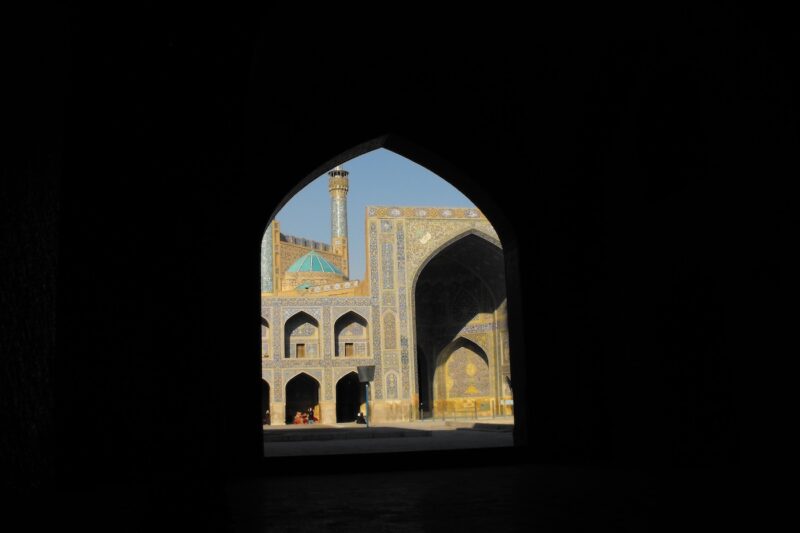
Nineteen, it says, are in Tehran. Twelve are in Kurdistan. The list being circulated includes Golestan Palace, the historic bazaar of Tehran, Marble Palace, the former Senate building, Sepahsalar Mosque, Salar Saeed Mansion in Sanandaj, Khosroabad, Naqsh-e Jahan, Chehel Sotoun, Falak-ol-Aflak, Tekyeh Biglarbeigi, Sabzabad Mansion, and the archaeology museum of Darreh Shahr, among others.
If true, it is devastating.
If only partly true, it is still devastating.
If impossible to verify, which is closer to our present condition, it is devastating in another register as well, because it means cultural destruction is now unfolding inside an information chamber built to prevent scrutiny.
That is the real obscenity of the moment. A state that has shoved 90 million people into digital darkness now asks the world to trust its accounting of damaged monuments. It has broken the glass, dimmed the lights, locked the exits, confiscated the witness statements, and then appointed itself chief curator of the debris.
Some damage is independently verified. UNESCO, as reported by the Associated Press, confirmed damage to Golestan Palace in Tehran, Chehel Sotoun in Isfahan, the Masjed-e Jāme of Isfahan, and buildings near the Khorramabad Valley. At Golestan, reports described shattered glass from mirrored ceilings, broken archways, blown-out windows, and damaged molding. That is not rumor. That is documented loss. It is already enough to justify outrage, mourning, and emergency conservation concern.
But the leap from a confirmed handful of sites to the ministry’s grand total of 56 takes us out of documentation and into fog.
And fog is where illegitimate regimes do some of their finest interior decorating.
A palace does not collapse like a spreadsheet. A mosque does not suffer “damage” in the abstract. There is a world of difference between shattered windows, loosened plaster, broken mirrorwork, damaged tile, structural stress, ruined display cases, dislodged ornament, and a building facing actual collapse. Yet blackout conditions flatten all of this into one convenient numeral: 56. It is the kind of number that arrives dressed as certainty while carrying very little usable detail in its pockets.
The tally has circulated in part through Iranistics_UT on Instagram, an account presenting itself as an educational Iran studies network tied to Tehran while operating from Canada. That does not prove the information false. It proves something more troubling. The information chain itself has become brittle, politicized, and structurally untrustworthy. When a state narrows the routes by which evidence can travel, every claim it releases enters the room already wearing stage makeup. It may be true. It may even be understated. But suspicion clings to it because of the method, not merely the content.
This is where the matter ceases to be only about architecture and becomes a matter of power.
Reporting during the blackout indicates that while the general public has been forced into silence, select users retained privileged access through what have widely been described as “white SIM cards,” filtered-exempt mobile lines for approved voices. Iran’s own government spokesperson, Fatemeh Mohajerani, reportedly said connectivity was being provided to those who could “better deliver the message.” It is hard to improve upon that sentence as a miniature of authoritarian aesthetics. The public gets darkness. The narrators get signal. Reality is not merely managed. It is tiered.
In such a system, heritage becomes politically useful in two opposite ways at once. In peacetime, it can be neglected, instrumentalized, underfunded, exposed, reduced to brochure material with columns. Then, once war damages it, the same state sweeps in draped in mourning black, hoists the wounded monument onto the stage, and demands unquestioned belief in its account of events.
The performance would be comic if it were not being staged among broken cornices.
And yet skepticism must not curdle into indifference. The danger is real. The confirmed damage is real. The vulnerability of the sites named in the broader list is real. Falak-ol-Aflak, the historic fabric of Isfahan, Sanandaj’s heritage houses, Tehran’s Qajar and Pahlavi structures, all of them sit inside a war zone where blast pressure alone can do terrible things. Heritage does not need a direct missile strike to be wounded. A nearby explosion can shatter glass, loosen centuries-old plaster, disturb timber, drop mirrorwork, and send delicate surfaces into dust. A building may remain standing and still have suffered a grave assault. Monuments, like people, can be injured without collapsing on cue for the cameras.
But the present obscenity is larger than wartime damage alone. This is a regime that did not suddenly become careless with heritage when bombs began to fall. It has long treated Iran’s past as something to exploit, distort, neglect, or monetize. The current blackout is not an exception to that pattern. It is merely its most theatrical lighting scheme.
Consider the larger landscape in which this 56-site claim appears. Iran has endured illegal excavations, looting, destructive development, shrinking protections around historic fabric, and official flirtation with the licit trade in antiquities. In Dorudzan, two probable Sasanian ostudans were reportedly damaged by treasure hunters who drilled into them and tore up the surrounding area with illegal digging. In Sabzevar, heritage activists warned that the protected historic fabric of the city had been drastically reduced under a ministry-backed boundary revision. In 2022, lawmakers even advanced the grotesquely titled bill “Optimal Use of Ancient Objects and Treasures,” whose logic treated antiquities less as the remains of civilization than as potential inventory.
Keep an eye out for my next blog post about “Heritage Vandalism in Iran: When the State Tries to Put Looting in a Suit”
This matters because it reveals the deeper problem: the Islamic Republic is not merely an unreliable narrator of cultural damage. It has also been one of the conditions of that damage.
A government that has tolerated, enabled, or fantasized about heritage as saleable material does not suddenly become a saint because a palace loses its windows in wartime. A state that cannot be trusted to guard archaeological sites in peacetime does not automatically become a transparent witness once missiles arrive. Quite the opposite. It appears at the scene with a prior record, a shaky alibi, and a clipboard.
So the correct response is neither gullibility nor sneering dismissal. It is insistence.
Insistence on independent documentation.
Insistence on photographs, condition reports, site-by-site assessments, testimony from local staff and conservators, and credible outside monitoring.
Insistence on precision.
Because precision is not a fussy academic luxury here. It is the difference between knowing whether a site needs emergency glazing, structural stabilization, debris mapping, object evacuation, conservation triage, or full rescue intervention. If 56 places have been harmed, each deserves to be described as itself, not folded into a statistic large enough for propaganda and vague enough for evasion.
This is why the internet blackout matters so profoundly. It does not merely obscure political events. It obstructs cultural evidence. It interrupts the ability of museum workers, residents, photographers, conservators, journalists, and ordinary witnesses to show the world what has happened. It slows proof. It lets the state retain editorial control over the ruins.
There is something especially monstrous in that arrangement. The state prepares the stage for the crime. War commits the first crime. Censorship arrives to tamper with the scene.
Cultural destruction, after all, is never just about old stones. A historic site is a storage device for continuity. It is where a society keeps craft, ritual, vanity, devotion, memory, beauty, argument, and historical nerve. Damage a monument and you do not only wound architecture. You diminish a people’s ability to touch the long sentence of their own existence.
That is why this moment feels so intolerable. It is a grotesque double hostage situation. The monuments are hostage to war. Their evidence is hostage to information control.
Yes, the ministry’s number may turn out to be broadly accurate. It may even prove conservative. But until independent verification catches up, it remains what it presently is: an official claim issued from inside a blackout, amplified through compromised channels, concerning damage to sites whose significance is beyond dispute and whose condition the world still cannot fully see.
That should trouble everyone.
Not because heritage is more important than human life. It is not.
But because a regime that can monopolize the story of shattered palaces will not hesitate to monopolize the story of shattered people too.