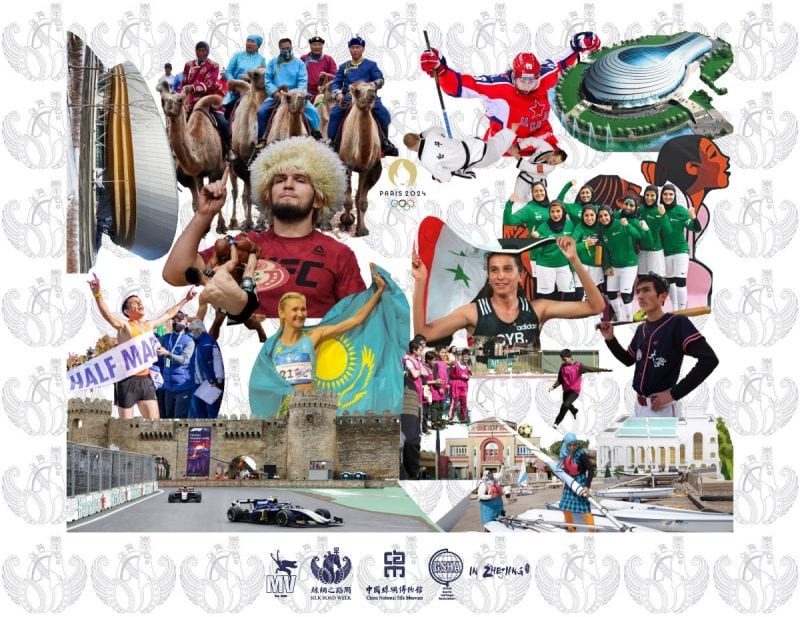
Culture Does Not Sit Quietly
Museums sometimes suffer from a fatal weakness for stillness. Objects sit. Labels behave. Visitors drift about in a hush so reverent it could iron a curtain. Silk Road Week 2021, thankfully, had other plans.
Held in Hangzhou from 18 to 24 June 2021, the second edition of Silk Road Week unfolded under the theme “The Silk Roads: Cultural Diversity and Sustainable Development.” Officially, it was an annual museum-led event honoring UNESCO’s Silk Road Programme, first introduced in 2020. In practice, it managed something far more interesting. It reminded us that the Silk Road was never a static ribbon of silk, spices, ceramics, and tasteful solemnity. It was movement. Contact. Exchange with a pulse.
That is where MUSEUMVIEWS, GSHA, and IMWD made their sharpest intervention. Their contribution to Silk Road Week 2021 celebrated the sports heritage of all 46 cities on UNESCO’s Silk Road Programme registry, treating athletic culture not as a decorative side dish to “serious” heritage, but as heritage itself. Not an afterthought. Not a crowd-pleaser wheeled in at the last minute. A central argument.
And a very good one.
The Silk Road is too often staged as a dreamy procession of robes, relics, caravans, and ceramics, all very elegant and very dead. But roads do not become historically important because objects travel politely along them. They matter because people do. Bodies do. Techniques do. Rituals do. Skills do. The body carries memory just as surely as the archive does.
Silk Road Week 2021 understood that with unusual clarity. The programme framed sport broadly, celebrating the histories and heritage of football, martial arts, equestrian sports, archery, wrestling, horse polo, board games, weight lifting, and other practices whose foundations may be found along the Silk Road. It is a gloriously expansive move. It breaks the old museum habit of treating culture as something that sits behind glass and suggests, instead, that culture also runs, rows, wrestles, trains, competes, and performs.
Cities in Motion
Take Xi’an, where the story becomes deliciously pointed. China is presented as the home of cuju, the 2,000-year-old original form of contemporary football. Suddenly football is not merely a modern obsession involving floodlights, transfer gossip, and fan despair. It acquires a much longer lineage. It becomes part of a Silk Road story in which games, like ideas, travel and mutate.
Then there is Yazd, where Pahlevani and Zurkhaneh rituals fold sport into ceremony, music, discipline, and ethics. Here athletic practice is not merely exercise. It is performance, philosophy, and strength in one breath. The “house of strength” is not a gym in the modern fluorescent sense. It is a cultural chamber in which movement becomes inheritance.
Venice offers another perfect turn of the kaleidoscope. Its tradition of voga alla veneta, Venetian-style rowing, is not merely picturesque local color for tourists armed with cameras and heroic linen budgets. It is civic identity in motion. Venice, city of water and spectacle, turns rowing into cultural grammar. The regatta is not an accessory. It is part of the sentence.
Elsewhere, the map keeps unfurling with enviable confidence. Karakorum brings the Naadam festival, with its archery, cross-country horse racing, and wrestling, all anchored in a nomadic tradition that has endured for centuries. Chennai arrives with cricket, that great imperial inheritance so thoroughly reworked that it now feels less like a British export than a civic religion. Bukhara and Shakhrisyabz point to kurash, Central Asia’s indigenous wrestling discipline, grounding the Silk Road in forms of strength, technique, and public contest. Baku flashes by with the Azerbaijan Grand Prix. Hangzhou, host city and home to the China National Silk Museum, appears not only as venue but as a strategic Silk Road hub with one eye on heritage and another on the coming Asian Games.
What emerges is not a novelty act called “sports, but cultured.” It is something stronger and much less patronizing. Sport is already culture. It carries collective memory. It binds cities to ritual time. It dramatizes values like discipline, endurance, prestige, and belonging. It tells communities who they think they are, and sometimes who they would like to become.
No Sepia, Please
Silk Road Week 2021 also deserves credit for refusing the sepia trap. This was not an exercise in embalming the past and admiring it from a tasteful distance. Again and again, the project made room for contemporary sports culture, especially women’s participation and visibility.
That thread gives the whole enterprise real bite.
From Bam, where Shahrdari Bam Women’s Football Club had amassed seven championships in Iran’s primary women’s league, to Herat, where Team Herat won Afghanistan’s Women’s Football League in 2020, to Jeddah, where the city’s women’s football league marked a watershed in Saudi Arabia, the programme repeatedly insisted that heritage is not a mausoleum. It is alive or it is nothing.
Almaty enters this conversation through statistics on women athletes and women in sports leadership. Muscat appears through efforts to bring more women into sports administration. Balkh reminds us, more painfully, that aspiration and access do not always arrive together, as female athletes pursue football and futsal despite limited facilities. Zanzibar, too, appears within a sporting world where women’s championships matter.
This is precisely where the Silk Road framing becomes most convincing. The Silk Road was never pure, singular, or still. It was a system of contact. A network of borrowings, rivalries, translations, and reinventions. Sport behaves in much the same way. A local game becomes a national obsession. A ritual becomes a modern training system. A city inherits one athletic language and adopts another. What survives is not purity. What survives is motion.
Heritage With Muscles
That may be the real brilliance of the MUSEUMVIEWS approach. It takes a subject often wrapped in velvet and gives it back its muscles. It presents the Silk Road not as a static heritage corridor but as a living route of bodies, practices, and public spectacle. Less still life, more ensemble cast. Less shrine, more stage.
And that feels right. Because culture does not only sit in vitrines.
Sometimes it rows through Venice.
Sometimes it wrestles in Central Asia.
Sometimes it races across Mongolia.
Sometimes it trains in Yazd.
Sometimes it plays football in Xi’an, Bam, Herat, or Jeddah.
Sometimes it insists on being seen not as ornament, but as life in motion.
Silk Road Week 2021 had the very good sense to recognize that. Better still, it recognized that the Silk Road itself was never a still image to be admired from a safe distance. It was a route of encounter. A choreography of exchange. A historical system in which bodies mattered as much as objects, and practices mattered as much as possessions.
Museums, at their best, understand this. They do not merely preserve what survives. They reveal how life moved. Silk Road Week 2021 did exactly that. It let the Silk Road breathe, sweat, compete, perform, and adapt. It let heritage stand up, stretch, and refuse to remain politely seated.
Which is only fair.
After all, the Silk Road was never still.
Sources
- GSHA / MUSEUMVIEWS / IMWD, Silk Road Week 2021 programme PDF: event dates, theme, 2020 launch, Hangzhou host context, the framing of sport across the 46 Silk Road cities, and the city-specific examples used throughout.
- City examples from the same PDF: Xi’an and cuju; Yazd and Pahlevani/Zurkhaneh; Venice and voga alla veneta; Karakorum and Naadam; Bukhara and kurash; Shakhrisyabz and kurash; Hangzhou as host city; Bam, Herat, Jeddah, Almaty, Muscat, Balkh, and Zanzibar on women and sport.