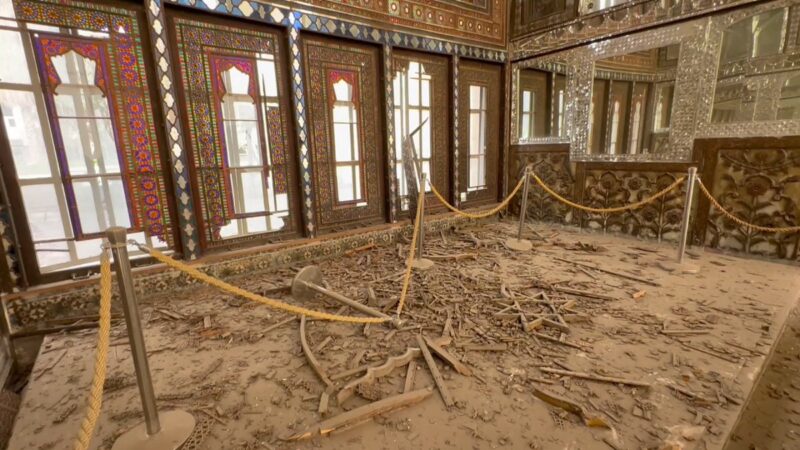
Golestan Palace in Tehran and the White City in Tel Aviv do not resemble one another at first glance. One is a Qajar palace complex of mirrorwork, stained glass, ornamental surfaces, and ceremonial rooms. The other is an urban field of balconies, staircases, pilotis, plaster, shade, and air. Yet they are, in their very different ways, cousins in the geography of light. Golestan multiplies illumination until it becomes spectacle. Tel Aviv modernism disciplines light until it becomes livable. Both are UNESCO World Heritage sites. Both are archives of how a society imagined modernity. And in both cases, war went first for the membrane: windows, mirrors, façades, doors, the thin and brilliant skin between inside and outside.
That matters because architecture is often the first casualty of war and the last thing granted a proper obituary.
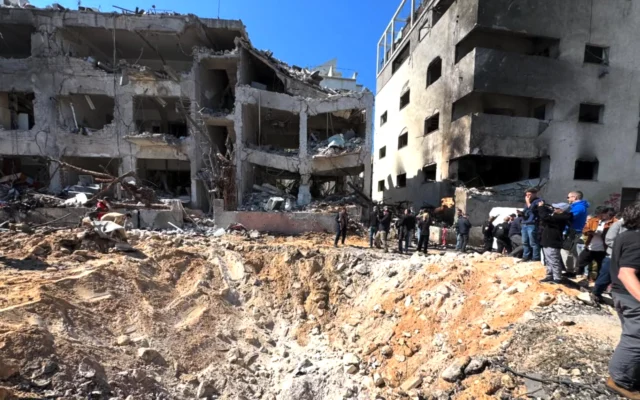
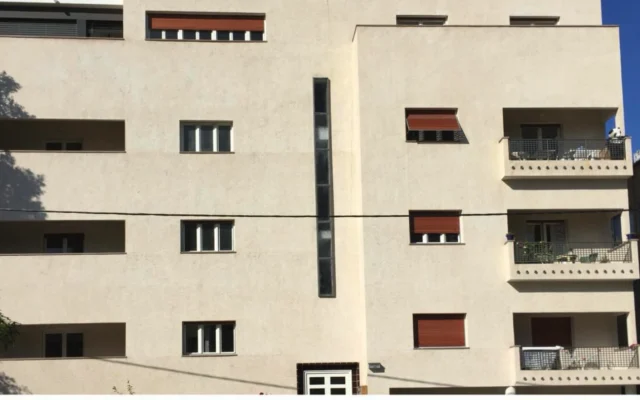
On 28 February 2026, an Iranian missile strike in Tel Aviv destroyed a neighboring apartment building and badly damaged 123 Yehuda Halevi Street, the Fruma Gourevitz house, one of the landmark buildings within the White City. Filipina caregiver Mary Anne Velasquez de Vera was killed. More than two dozen people were injured. The ground-floor Grasyani House café was destroyed. Architect Alon Bin Nun, whose firm had restored the building, said it was, for the moment, uninhabitable: windows blown out, rooms exposed, domestic life abruptly edited by blast pressure. The Art Newspaper also reported damage to a second White City Bauhaus building, as well as to the glass façade of Habima, Israel’s National Theatre.
This is not a minor architectural anecdote pinned to a larger military story like a paper label on a museum crate. The White City was inscribed on the World Heritage List in 2003 because it is not one photogenic façade but a large-scale urban experiment: more than 4,000 modernist buildings shaped by Patrick Geddes’s plan and by architects who adapted European modernism to local climate, local habits, and local traditions. White here was never merely a color. It was climatic reasoning in plaster. Recessed windows, shaded balconies, cross-ventilation, and surfaces that answered heat with reflection rather than surrender were not decorative whims. They were a theory of how modern urban life might be made humane.
This is why a café can matter as much as a palace.
Not in grandeur. Not in dynastic weight. Not in ornament. But in cultural meaning.
A palace condenses power. A domestic street condenses life. A palace stores sovereignty in halls, mirror chambers, and ceremonial rooms. A modernist neighborhood stores it in stairwells, balconies, family apartments, corner cafés, and the daily civic theater of people learning how to live together under a difficult sun. To strike Golestan is to wound a monumental archive of Iranian statecraft and artistry. To strike the White City is to wound an archive of ordinary modern life: adaptation, collectivity, modesty, hygiene, and the social ambition of architecture stripped of pomp but not of intelligence.
The Fruma Gourevitz house makes that point with painful clarity. It was built between 1935 and 1937 by Mordechai Zabrudsky and Yitzhak Belkes. It was not an anonymous shell. Much of it still belonged to the founding family’s descendants. It had authorship, memory, continuity, and a café woven into the neighborhood below. This is also why it matters that The Times of Israel named the building, dated it, located it, and restored authorship to what might otherwise have been flattened into the phrase blast damage. That phrase is so bloodless it sounds as if it were drafted by a filing cabinet. But buildings are not rubble the moment they are hit. They remain buildings, with designers, residents, uses, neighbors, and meanings. A warhead does not cancel authorship. It merely tries to.
This is where the comparison with Golestan becomes illuminating rather than competitive.
On 2 March 2026, UNESCO issued a public statement saying Golestan Palace had reportedly been damaged by debris and shock waves following an airstrike to Arag Square in the site’s buffer zone, and it explicitly recalled protections under the 1954 Hague Convention and the 1972 World Heritage Convention. The language was direct, morally legible, and unmistakably heritage-forward. Golestan was named at once as a cultural emergency.
Public language around damage in Tel Aviv has not always achieved that same clarity. Verification takes time. Institutions built on diplomacy prefer to move cautiously until the evidentiary floor stops wobbling. Fine. Bureaucracies do love a waiting room. But public language is never neutral stage furniture. It tells the world what sort of event it is witnessing. One statement lands like an alarm. The other can land like a file being opened.
That tonal difference matters because heritage does not only need protection. It needs legibility.
If a damaged palace in Tehran is immediately understood as a cultural emergency, while a damaged World Heritage urban fabric in Tel Aviv is treated as an architectural footnote to a geopolitical drama, then the problem is not simply uneven coverage. It is uneven recognition. Much reporting on Golestan swiftly foregrounded the site’s heritage status and the injury to a place already legible as culture. Much reporting on Tel Aviv, understandably, led with the dead, the injured, the crater, the demolished residential block. Death should lead. Mary Anne Velasquez de Vera is not a tragic preface to a façade. But once those facts are established, the heritage dimension should not still be waiting in the wings, powdered with plaster dust, for someone to remember it belongs on stage too.
That is the distortion worth naming.
Golestan is readily legible to international culture writing as civilization, empire, artistry, splendor, memory. The White City is more often rendered through the colder idiom of apartment blocks, emergency response, property damage, and resilience. The result is a double caricature. Iran is exoticized. Tel Aviv is administratively flattened. One becomes velvet. The other becomes concrete dust. Neither is fully understood.
And yet these sites are not opposites. They are mirrors with different frames. Golestan embodies a 19th-century synthesis of Persian arts and architecture with European motifs and technologies. The White City embodies a 20th-century synthesis of modernist planning with local cultural traditions and climatic conditions. One works with glass, mirrors, gardens, ornament, and ceremonial splendor. The other works with depth, shade, airflow, plaster, and disciplined brightness. One makes light theatrical. The other makes it habitable. Both are forms of intelligence. Both are records of adaptation. Both remind us that modernity is never abstract. It has surfaces. It has rooms. It has weather.
I write this as an Iranian-born American, raised in Iran in a Muslim family and also among Armenian Christian friends and Bahá’í relatives. I have never been to Tel Aviv. I do not know the White City through lived experience. But care should not require autobiography as proof of entry. I do not need childhood memories on Yehuda Halevi Street to know that a UNESCO-listed modernist building matters, that the death of Mary Anne Velasquez de Vera matters, that displaced residents matter, and that a destroyed café beneath a preserved façade matters.
I am no less unsparing toward the long failure of Iranian and international heritage institutions to protect Iran’s past. The Islamic Republic has repeatedly disfigured the country’s cultural inheritance for profit, ideology, and contempt toward what it did not invent. I knew Golestan differently. I lived near it in Tehran while researching the foundational history of museums in Iran for my doctoral thesis, work I am now revisiting for publication. To me, Golestan remains a place of intimate cultural memory.
But intimacy is not the test of value. A regime’s crimes do not make a civilization’s heritage expendable. Nor do they excuse the demotion of another people’s cultural loss into administrative background noise. If care arrives only where politics permits it, then what is being defended is not heritage, but preference in ceremonial dress.
The larger danger, then, is not only physical destruction. It is narrative sorting. A palace receives the full tragic orchestra. A modernist neighborhood gets muffled percussion from another room. One loss is granted immediate cultural solemnity. The other waits backstage for someone to recall that balconies, cafés, staircases, and family apartments also belong to the history of civilization.
They do.
World heritage is supposed to mean that a white wall and a mirror hall are both legible as inheritances of human imagination, not because they are identical, but because they are equally irreducible to military shorthand. The test is not whether Tel Aviv should eclipse Tehran, or Tehran Tel Aviv. The test is whether both can be described under the same ethical light without one becoming glamorous ruin and the other municipal paperwork.
These are not side plots of war. They are among the places where war reveals what it thinks is disposable.
If that standard is applied unevenly, then the cracks are not only in plaster and glass. They are in the language meant to protect them.
SOURCES
UNESCO World Heritage Centre, “White City of Tel-Aviv – the Modern Movement,” including its 2003 inscription, Patrick Geddes plan, and Outstanding Universal Value as a large-scale modernist ensemble adapted to local cultural traditions and climatic conditions. (whc.unesco.org)
Jessica Steinberg, “Historic Tel Aviv Bauhaus building damaged by Iran missile explosion,” The Times of Israel, 5 March 2026, identifying 123 Yehuda Halevi Street as the Fruma Gourevitz house, naming Mary Anne Velasquez de Vera, describing the damage, and giving the building’s dates, architects, and family ownership. (timesofisrael.com)
UNESCO, “UNESCO expresses concern over the protection of cultural heritage sites amidst escalating violence in the Middle East,” 2 March 2026, updated 9 March 2026, stating that Golestan Palace was reportedly damaged by debris and shock waves after an airstrike to Arag Square in the site’s buffer zone and recalling protections under the 1954 Hague Convention and the 1972 World Heritage Convention. (unesco.org)
Hadani Ditmars, “Unesco World Heritage buildings in Tel Aviv damaged by Iranian missile strike,” The Art Newspaper, 5 March 2026, reporting damage to two Bauhaus buildings in the White City and to Habima’s glass façade. (theartnewspaper.com)
UNESCO World Heritage Centre, “Golestan Palace,” including its description and Outstanding Universal Value as a Qajar-era synthesis of Persian arts and architecture with European styles and technologies. (whc.unesco.org)