Iran Cannot Be a Matter of Indifference : Reflections on art, conscience, museums, and the limits of solidarity
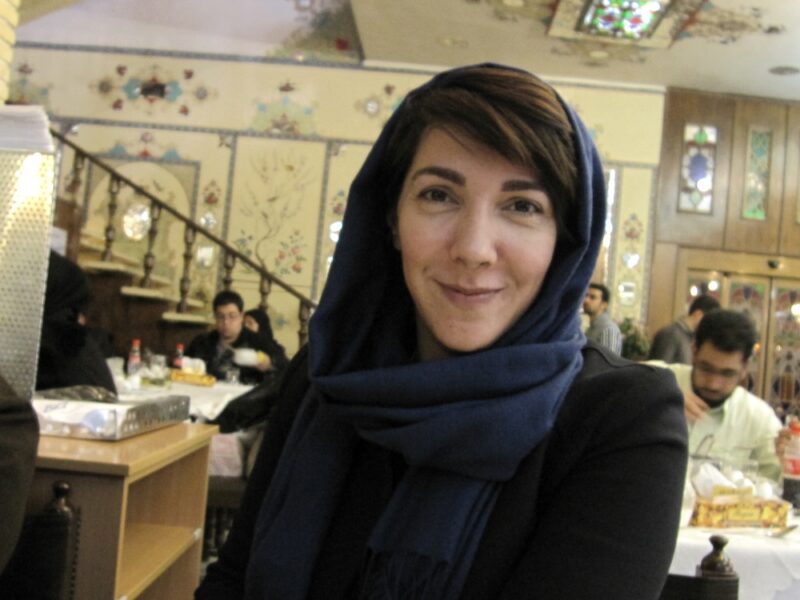
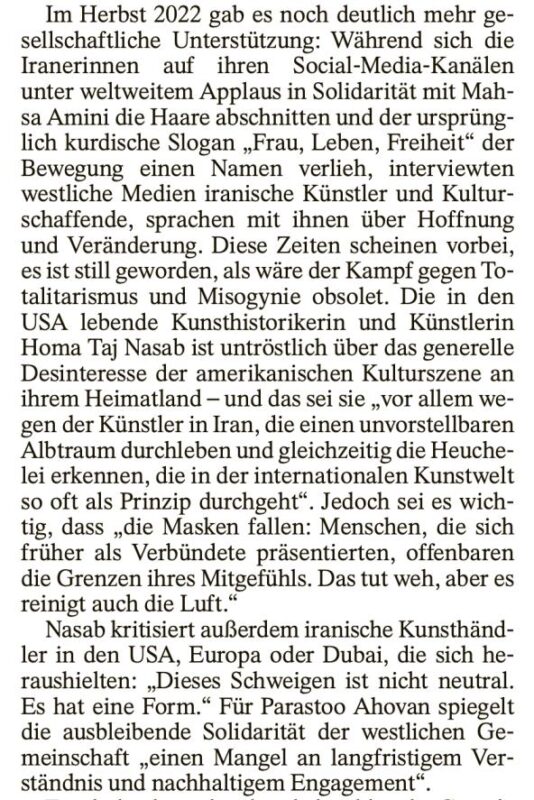
In February 2026, the Frankfurter Allgemeine Zeitung published an article by Jana Talke on feminist Iranian artists in the diaspora and the diminishing attention their work receives in the Western cultural sphere. I appeared in it briefly, quoted as an art historian and artist living in the United States. Briefly is how the international art world increasingly seems to prefer Iran: as a passing mention, a tasteful pang, a tragic aside between biennials.
But Iran is not an aside.
It cannot be reduced to a panel discussion, a slogan, or a temporary fit of institutional conscience. It is not a mood, not a metaphor, not a curatorial weather system. It is a country full of people, including artists, who continue to live and work under pressure so relentless that from the outside it can look almost unreal. Inside Iran, however, it is quite real. There is nothing theoretical about surveillance, internet blackouts, prison, torture, or the steady corrosion of daily life. There is also nothing theoretical about courage.
I was born in Iran and was nine years old when the Revolution arrived and rearranged everything. Revolutions do not politely knock on the door of childhood. They enter like uninvited stage managers, cut the lights, rewrite the script, and insist everyone call it destiny. We did not leave until late 1983. By then the Iran-Iraq War had already become the background noise of daily life. Childhood acquired an early curfew. The ordinary business of growing up was interrupted by sirens, slogans, and the sudden awareness that history had terrible timing.
Exile, when it comes, does not arrive cleanly. It travels with you. It settles into the body and unpacks at its leisure.
Years later, I returned to Iran to conduct doctoral research on the early development of museums in the country, roughly between 1870 and 1941. That work remains close to me even now. It became the foundation for a book I am currently finishing, a study of museum development more broadly, with Iran not merely as a case study but as a key. Museums matter to me because they are institutions built to preserve memory, and memory is rarely innocent. It can console, dignify, and clarify. It can also irritate power, which is one reason power prefers amnesia.
When a society is under political strain, the preservation of memory becomes quietly radical.
For most of my life, I was not publicly outspoken about politics. During my doctoral work at Oxford, there was no shortage of pressure to interpret Iranian cultural history through overtly political frameworks. I resisted. For me, scholarship itself held moral value: careful archival work, fidelity to chronology, respect for ambiguity, patience with evidence. Staying with the record felt like a form of integrity. Perhaps even a quiet form of dissent. Art and scholarship do not need to shout in order to speak.
Yet history has a way of dragging speech out of those who would have preferred to remain with their books.
In recent years, and especially after October 7, I found myself drawn into public conversations I had once avoided. I spoke openly against the atrocities committed by Hamas, and the reaction was swift. Followers disappeared. Some were curators and colleagues in European museum circles whom I had previously respected. Watching compassion evaporate and slogans rush in to fill the vacuum was clarifying in the grimmest way. It was like watching conscience get replaced by costume. The costume, naturally, was very confident.
That experience taught me something I had perhaps always known but not yet named clearly enough: art and politics meet not in ideology, but in conscience. Art does not need to become propaganda in order to bear moral weight. Sometimes it is political simply because it refuses amnesia. Sometimes it insists on seeing.
My concern today is not primarily for myself, nor even for artists in the diaspora. It is for the artists still inside Iran. They are trying to keep working in conditions that most people outside the country can scarcely imagine. Internet access is restricted. Surveillance is pervasive. Protest can mean imprisonment. In some cases, it means death. And still, the work continues. Painters paint. Filmmakers film. Writers write. The creative impulse, stubborn old creature that it is, seems remarkably difficult to kill.
But artists in Iran are also watching us.
They see which institutions speak and which remain silent. They see how quickly public concern expires once the first flush of outrage has passed. They see which forms of suffering are treated as historically important and which are treated as inconvenient. This is the heartbreak I referred to in the FAZ article, not simply the fading of attention, but the spectacle of hypocrisy passing itself off as principle. It is one thing to be abandoned by governments. It is another to be abandoned by cultural institutions that have spent years congratulating themselves on the language of solidarity.
Still, there is a severe kind of clarity in this moment. Masks are slipping. People who once styled themselves as allies are revealing the limits of their empathy. It hurts, yes. But it also clears the air.
Silence, after all, is rarely empty. It has structure.
One of the more unsettling forms of this silence has come from Iranian art dealers operating in the United States, Europe, and Dubai. Many of these galleries have built reputations around championing Iranian artists. They understand perfectly well how to market Persian complexity, exile, gender, longing, rupture, beauty, and resistance. They can write an elegant press release with one hand while pouring wine with the other. But when events in Iran demand moral clarity, the public statements vanish. Apparently courage, like shipping, incurs additional costs.
That silence is not neutral. It has a shape. It marks the border between aesthetic enthusiasm and political courage. Artists inside Iran may not always say so publicly, but they notice. They remember. When the political climate eventually changes, as it will, the cultural record will include not only the artworks but the institutions that claimed to stand beside them and somehow always managed to stand just slightly to the side.
This should trouble museums in particular.
Museums often describe themselves as spaces of memory, conscience, and critical reflection. Fine. Then let them behave like it. Museums are not neutral vaults. They are authors of cultural memory. What they choose to collect, exhibit, interpret, and ignore determines how future generations will understand the present. If institutions genuinely believe art has civic meaning, then Iranian artists should not appear in exhibitions only once the danger has become historical and therefore glamorous. Everyone loves dissident art once it can be safely framed, insured, and hung under flattering lights.
To remember after the fact is easy. To remember while events are still unfolding requires courage.
Museums can commission writing, host conversations with artists in exile, acquire works that document this historical moment, and build archives that preserve not only the finished object but the conditions under which it was made. They can stop treating Iran as a periodic emergency and begin treating Iranian artists as essential participants in the contemporary cultural record.
My own work now moves between visual art and theatre. At heart, I am a storyteller. My mother was a painter, and her devotion to making shaped my understanding of artistic life more deeply than any theory ever could. After our family arrived in the United States, she began painting almost immediately and continued for decades. I remain convinced that painting sustained her in ways that were both emotional and physical. I started by drawing portraits as a teenager, then moved into theatre and film. Academia interrupted that path for many years, though not without purpose. Around 2012, after leaving academia, I returned fully to storytelling. Now I paint full-time and write plays. The plays are dark-comedy musicals, because sometimes the only honest way to tell the truth is to let it sing.
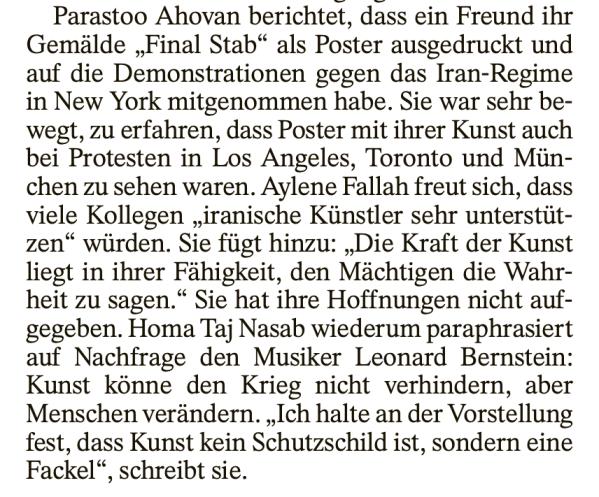
When Jana Talke asked me about the role of art in moments like this, I paraphrased Leonard Bernstein: art cannot stop wars, but it can change people. And when people are changed, made braver, more lucid, less willing to lie to themselves, they act differently. Over time those actions accumulate, and history bends. Slowly, often insultingly slowly, but it bends.
This is why art matters even when it appears powerless. Art is not a shield. It will not prevent violence. It will not topple tyranny on its own. But it can illuminate the darkness. It can refuse erasure. It can keep memory alive when both authoritarianism and fashionable outrage would prefer the record be tidied up and put away.
Since that interview was published, events have accelerated yet again. War now unfolds over a landscape already saturated with grief. Suddenly, some of the very people who found little to say during years of internal repression have discovered a passionate concern for Iran. The timing is almost baroque. For many Iranians, the grief is now layered: mourning the victims of a brutal regime while also witnessing the destruction that comes with war. Worse still is the strange spectacle of being instructed, by distant commentators and algorithmic choirs, how one ought to mourn one’s own country. The lecture arrives, as lectures often do, with a tone of humanitarian superiority and a memory like a goldfish.
What the Iranian people need least is another performance.
What they need, what Iranian artists need, is seriousness, courage, and memory.
I do not only hope for Iran. I pray for it. I pray for endurance for the people living there now, especially the women who have carried the intellectual and moral weight of resistance for decades. Their courage does not always resemble the heroic postures beloved by cinema. More often it looks like surviving another day, speaking when possible, refusing inward collapse.
And for Iranian artists, my wish is simple: that they continue to make things.
Because if artists stop making, evil wins too neat a victory.
If art is indeed a torch, then its task is not to pretend the darkness is gone. Its task is to keep the flame alive.
Citations
Jana Talke, “Iran kann uns nicht egal sein” / “Iran Cannot Be a Matter of Indifference to Us,” Frankfurter Allgemeine Zeitung, February 21, 2026.