When societies face rupture, they don’t survive by forgetting who they are. They survive by learning how to see themselves anew.
When societies face rupture, they do not survive by amnesia. They survive by learning how to recognize themselves again: clearly enough to move forward, and carefully enough not to confuse modernization with self-erasure. That was one of the great political and cultural wagers of early modern Iran. Heritage, in this setting, was not a velvet backdrop for national feeling. It was part of the apparatus of future-building. This essay draws from a larger book-length project, Architecture of Renewal: How Cultures Use Heritage to Move Forward, which follows that argument through the making of modern public culture in Iran.
Long before Iran opened a public museum, it cultivated something almost as consequential: museum thinking. In the early decades of the nineteenth century, a small group of young Iranians from elite families traveled abroad and returned home not merely dazzled, but observant. They did not write like tourists overcome by chandeliers. They wrote like auditors of institutions. Their travelogues and diaries recorded where museums came from, what they collected, how they expanded, how they were funded, who guarded the collections, and how many visitors moved through them. Nearly a century before Iran founded its first public museum in 1916, the museum had already entered the Iranian imagination.
One of the earliest figures in this story was Mirza Saleh Shirazi (1790-1845), who visited Britain in 1815 and described encounters with institutions such as the British Museum and the Ashmolean. For him and for other early travelers, a museum was not simply a room filled with remarkable things. It was a system. It organized knowledge, staged visibility, and made learning legible through arrangement. The important revelation was not only the object, but the order around the object: the choreography that turned accumulation into public meaning.
Many travelers referred to museums as ajayeb-khana, or “houses of wonder,” a phrase that echoed Europe’s wunderkammer while sounding entirely at home in Persian cultural life. The phrase matters because it captures the transitional texture of the moment. Iran was not passively borrowing a foreign institution whole. It was translating it, testing its grammar, and deciding what kind of local life it might have. Even at this early stage, the museum was less a building than a concept under adaptation.
Iran’s first museum space appeared later, but not as a public institution. Following his first European journey in the late 1860s, Nasser al-Din Shah (1831-1896), the fourth king of the Qajar Dynasty (1789-1925), established a Museum Hall, or Talar-e Muze, within the Golestan Palace complex. Modeled on a European-style kunstkammer, it was private and highly restricted. Very few were permitted to view its collections. That detail is not incidental stage dressing. From the outset, museums in Iran, as elsewhere, were entangled with access, authority, and the politics of display. Public culture began, rather deliciously, behind a closed door.
By the late nineteenth century, Iranian intellectuals were articulating a broader and more ambitious account of what museums could be. E’temad al-Saltana (1843-1896), court historian to Nasser al-Din Shah and an accomplished Europhile, described the museum as a place that gathers ancient objects, rarities, crafts, memorable things with scientific qualities, and the arts, discoveries, traditions, and norms of every period. He called the museum the measure of wisdom and the mirror of perception. This was no small compliment. It cast the museum as an instrument for collective understanding, a civic technology for sharpening how a society sees itself across time.
Iran was hardly alone in moving toward this view. By the 1890s, museum professionals across Europe and North America were converging around a more standardized idea of the national museum. In 1896, G. Brown Goode, Director of the United States National Museum, described its ultimate purpose as the advancement of knowledge and the preservation of works of art that hand down the history of the nation and the world. Museums, in other words, had become engines of narration as much as repositories of preservation. Iran was not standing outside that conversation. It was listening carefully, translating strategically, and preparing its own institutional answer.
After the Iranian Constitutional Revolution (1905-1911), observation gave way to institution-building. In 1916, the Ministry of Education founded Iran’s first public museum, the Museum of Culture (Muze-ye Ma’aref), also referred to as the National Museum. Its creation helped ignite the proliferation of museums and cultural organizations across the country, laying foundations for a new public life organized around heritage, education, and visibility. The museum was no longer only a courtly chamber or an imported idea. It had become a public instrument, a space in which the state, the citizen, and the past could begin to encounter one another under modern conditions.
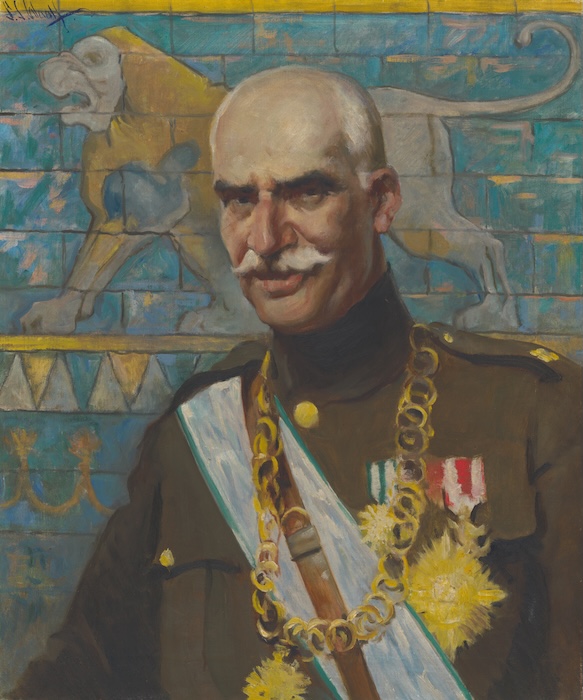
Under Reza Shah Pahlavi (b. 1878, r. 1921-1941), founder of the Pahlavi Dynasty (est. 1925-), museums became central to a fourfold state initiative: centralization, secularization, unification, and modernization. These aims were pursued not only through armies and laws, but through cultural institutions. Museums formed public spaces where, as my doctoral research argues, aesthetics and politics meet and champion one another. They reflected a larger priority: shaping the nation by giving form to a people and their culture. Heritage, in this moment, was neither passive nor nostalgic. It was strategic.
That point deserves emphasis because it unsettles a habit of thought that still clings to culture like old dust in a vitrine. We are often tempted to treat heritage as decorative, backward-looking, or faintly ceremonial: lovely, perhaps, but secondary to the “real” business of governance. The early twentieth-century Iranian case suggests the opposite. Cultural renewal was built through institutions, policy, and public life. It was method, not mood. Museums mattered not because they embalmed the past, but because they helped convert inheritance into orientation. They trained attention, organized memory, and made continuity visible enough to be inhabited.
Iran’s story therefore exceeds the boundaries of national history. It offers a blueprint for how societies use culture to build futures under pressure. When a people invest in ways of seeing, preserving, and sharing their past, they do more than honor what has been. They construct the conditions under which a future becomes imaginable. In moments of rupture, culture does not merely survive the drama. It walks onstage carrying part of the script.
That is one reason this history continues to matter, and why I keep returning to it. The making of museums in Iran was never only about collecting beautiful things or arranging old stones under better lighting. It was about building public forms sturdy enough to hold continuity without collapsing into nostalgia. That question remains with us. How does a society move forward without erasing itself? Architecture of Renewal, the larger work from which this essay emerges, follows that question through rooms, institutions, and acts of display that still have much to teach us about identity, legitimacy, and the difficult art of future-building.
Homa Taj Nasab is a visual artist, author, and playwright whose work moves between image, narrative, and public memory. Current projects include the books Architecture of Renewal and BREATHE, and the plays Ferdowsi and Moments in Spring.