Treasure Hunters Broke Sasanian Ostodans, in Marvdasht, Fars Province
In my earlier on Iran’s “silent earthquake,” I argued that the missiles arrived late to a demolition already underway. Land subsidence, corruption, neglect, and official indifference had already been eating through the country’s cultural foundations long before war added its own racket. But there is another chapter to this destruction, and it is less geological than theatrical. It concerns not only what is collapsing beneath Iran’s monuments, but what is being smashed above ground, in full view, by treasure hunters, speculators, bureaucrats, and lawmakers who have begun speaking about the past in the language of inventory, licensing, and sale.
This is not merely negligence. It is heritage vandalism in its fullest form. Not only the hammer blow, but the arrangements made before it. Not only the looter with a drill, but the official who redraws a boundary, weakens a protection, invents a loophole, or muses aloud about antiquities as export commodities. The Islamic Republic now speaks of national heritage as though it were a troublesome estate whose contents might be sold off, thinned out, rezoned, or quietly escorted toward the market.
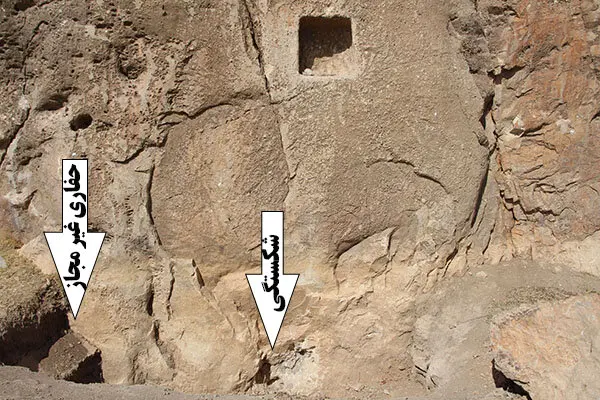
The crudest version of the crime is still useful, because vulgarity clarifies. In Dorudzan, in the Marvdasht region of Fars, two probable Sasanian ostudans were reportedly damaged by treasure hunters. The lower sections were broken, one was drilled with an electric tool, and the surrounding area was ripped apart by extensive illegal digging, including a large winding tunnel more than six or seven meters long. As Iran-based heritage researcher Siavash Aria has noted, ostudans were repositories for the bones of the dead in the Mazdayasna tradition, and they matter not only to archaeology but to the study of social history and, at times, political history in ancient Iran. Yet they were attacked like stage props thought to conceal pirate gold. Iran’s antiquity, in this scene, is not being studied or mourned. It is being interrogated with power tools by men who have mistaken civilization for a slot machine.
More revealing still is what the attack says about the conditions around it. Aria said many ostudans have long been left exposed and, in recent years, heavily targeted by smugglers and treasure hunters. In Dorudzan, he pointed to drill marks on the upper and side sections of one ostudan, along with apparently recent holes and older traces of illegal excavation. The picture was not of one midnight fit of greed, but of repeated incursions under chronically weak supervision. He explicitly tied that neglect to local and county heritage authorities, village officials, and other responsible bodies, and said he had reported the matter to the provincial heritage director in Fars. The scandal was not simply that looters arrived. It was that they found the stage already unwatched.
And yet it would be too convenient to leave the blame there, with the looters in the hills. A state does not need to swing every hammer itself in order to become complicit in the ruin. It can cultivate the conditions in which destruction becomes easier, cheaper, and more profitable. It can lower the guardrails, drain the law of seriousness, and let appetite improvise the rest. Once that happens, the vandal at the archaeological site and the official at the ministry desk are no longer opposites. They are colleagues separated only by dress code.
Take Sabzevar. Reporting based on leaked documents showed that the protected historic fabric of the city had been reduced from 275 hectares to 198 hectares under a ministry-backed boundary revision. Heritage activists argued that this was no technical tidying-up exercise. It was a permission slip dressed as planning. Once nearly a third of the protected area is shaved away, demolition becomes easier, new construction becomes easier, and the old urban fabric is quietly pushed outside the circle of care. Then the damage that follows can be cited as proof that the area had already lost its historic value. Memory, in this system, is not always erased. Sometimes it is simply rezoned.
This is why the language used by heritage activists matters. Historical monuments, archaeological sites, old quarters, shrines, burial complexes, ruined walls, neighborhood fabrics: these are not decorative leftovers from a picturesque dead past. They are cultural borders, places where a civilization recognizes itself. A government that expects sacrifice for its physical frontiers but cannot defend its cultural ones is not merely negligent. It is presiding over a slow-motion surrender, not to foreign armies, but to greed, speculation, and official convenience.
And this is where the scandal darkens from neglect into design.
In 2022, a group of Iranian lawmakers submitted a bill with the deceptively hygienic title “Optimal Use of Ancient Objects and Treasures.” The title sounds as though it were coined by an undertaker with a marketing degree. The explanatory text explicitly invoked Egypt as an example, claiming that in some places antiquities sales sustain local livelihoods. It then advertised the proposal’s supposed benefits with startling bluntness: turning Iran into a regional hub for the buying and selling of antiquities, bringing foreign currency into the country, and creating a new revenue line for the heritage ministry. The publicly available text lists 46 signatories. Parliament was not merely tolerating the commodification of the past. It was trying to market it.
The scandal was not just that lawmakers wanted a cleaner, licensed market in old objects. The deeper scandal was that the bill created a pathway by which objects recovered through unauthorized digging could be registered with the ministry, warehoused in a ministry system, assigned a value, and, if not acquired by state institutions, eventually moved into private ownership and sale, first to Iranians and later to foreign buyers. The same text proposed repealing the post-revolution legal measure aimed at preventing unauthorized excavation for antiquities. Whether one prefers to call that legalization, laundering, or bureaucratic alchemy, the result is the same: a route from the earth to the market, with the state standing at the toll booth.
That is why illegal excavation cannot be tucked into a tasteful subordinate clause. Dorudzan itself suggested not a single midnight raid but a pattern of repeated incursions, some apparently recent, others older, unfolding at a site so weakly supervised that the evidence of intrusion was left almost to narrate itself. A system that creates legal channels for the circulation of freshly unearthed antiquities in a country already ravaged by illicit digging does not neutralize looting. It rewards the logic of looting. It tells every opportunist with a shovel that the state may yet catch up, tidy the paperwork, and convert the spoil into an asset. The grave robber becomes an unofficial supplier waiting for administrative recognition. Looting, in other words, is not being suppressed. It is being courted in legislative language and dressed up as economic policy.
To be fair, the Islamic Republic still performs occasional gestures of innocence. Iranian law continues, on paper, to prohibit the sale of cultural property obtained through illegal excavation. Public reporting on the first licensed auction of “licit” historical property in late 2024 reiterated that ban, citing Article 562 of the Islamic Penal Code. The same coverage stressed that the auction framework concerns only “licit” movable cultural property. But this is precisely what makes the spectacle so grotesque. On one side of its mouth, the state says illicit excavation is forbidden. On the other, it creates auction machinery, licensing systems, and a national working group for the trade in “licit” historical objects. One does not need openly to bless looting if one can construct a market in which provenance arrives washed, combed, and carrying identification.
By late 2024, that machinery was no longer theoretical. The National Working Group for Trade in Licit Historical and Artistic Movable Property had issued the first official license for an auction of “licit” historical and cultural objects in Iran. Critics warned that the framework was murky and dangerous, precisely because the border between the licit and the illicit is never as clean in practice as it appears in ministerial prose. A museum is supposed to interrupt the appetite of the market, not accessorize it. Yet here was the state on the auction floor in borrowed moral robes, insisting that history could be sold responsibly if everyone agreed to use the correct forms.
Seen in this light, the smashed Sasanian ostudans, the shrinking historic fabric of Sabzevar, and the parliamentary push to normalize the sale of unearthed antiquities are not separate scandals. They are acts in the same play. In one scene, treasure hunters claw at a mountain for fantasies of hidden wealth. In another, officials redraw protective boundaries until heritage becomes easier to demolish. In another, lawmakers cite Egypt, promise export income, and sketch out a future in which antiquities circulate as revenue-bearing goods. Different costumes, same plot. The republic does not always destroy heritage with its own hands. Sometimes it merely lowers the lights, unlocks the side door, and lets greed take the stage.
This is why the phrase heritage vandalism is not too strong. Vandalism is not only the instant a monument is struck. It is also the patient manufacture of conditions in which the strike becomes profitable, lawful-looking, or politically convenient. It is the refusal to guard an archaeological site. It is the reduction of a protected historic zone by ministerial order. It is the conversion of collective inheritance into a revenue model. It is the replacement of stewardship with appetite.
Iran today faces war damage, land subsidence, illicit excavation, speculative development, and chronic state mismanagement all at once. Any one of these would be dangerous. Together they produce a slow civic dismemberment. A civilization is not ruined only when its monuments collapse. It is ruined when the guardians of memory begin to sound like brokers, and when the state no longer merely fails to stop the looter at the gate, but starts drafting the paperwork that could one day hand him a receipt.
Please read: When the State Counts the Ruins in the Dark