Yesterday, Golestan’s windows learned the oldest lesson in architecture: history isn’t “over,” it just sometimes arrives without taking its shoes off.
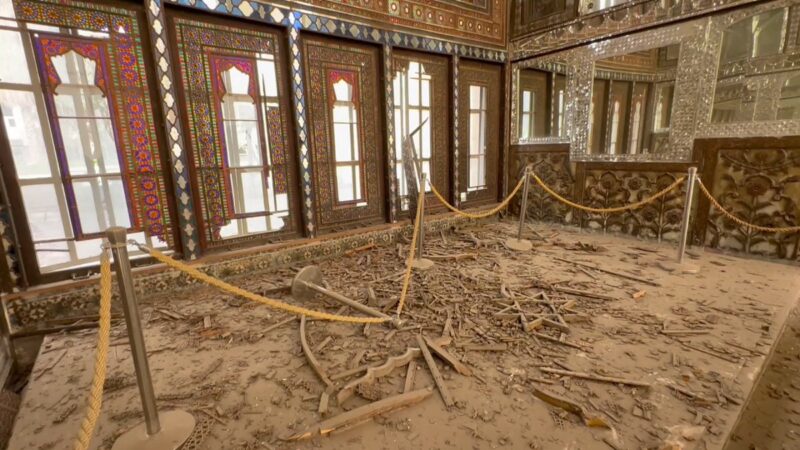
Reports out of Tehran say the Golestan Palace complex was damaged after an airstrike hit near Arg (also rendered “Arag”) Square, within the site’s buffer zone. The shock wave and debris, we’re told, reached what a palace does best and fears most: its surfaces. Windows. Doors. Mirrors. The very apparatus of reflection.
If you’ve never been to Iran, you might picture “palace” as a single, moody building with a tragic chandelier and a convenient throne. Golestan is not that. Golestan is a cast. A troupe. A walled royal precinct made of courtyards, pools, tilework, towers, reception halls, mirror rooms, museums, and an enduring Persian garden logic that tells you where to stand, where to breathe, and when to gasp.
Which is why broken glass here isn’t just broken glass. In Golestan, glass is a philosophy.
To understand why this damage lands like a line reading with the lights suddenly up, we need to meet Golestan across its long career: from Safavid seedling, to Qajar blockbuster, to modern museum, to UNESCO emblem, to the present moment when war reminds everyone that heritage sites don’t live in a vacuum, they live in cities.
In the Safavid period (1501–1736), the area that would become Tehran’s royal citadel was already a place of trees, walls, and attention. Golestan’s own official history traces the site back to Shah Abbas’s era (1571–1629), even citing an early modern traveler describing Tehran’s trees around the royal precinct. That detail matters. Persian architecture is often misread as “decoration,” when it’s really environmental intelligence: shade as strategy, water as geometry, enclosure as calm. A palace complex built from a garden outward doesn’t merely house power, it stages power. You enter, you slow down, you watch water hold the sky, and before you know it you’re behaving.
Then the Qajars (1789–1925) arrive, and Golestan becomes the capital’s main theatre. Over the nineteenth century, the palace is rewritten into a new visual language, one that keeps Persian craft at its core while flirting openly with European technologies and motifs. That “flirtation” is not an apology. It’s a statement: Iran is watching the world, and the world is watching back.
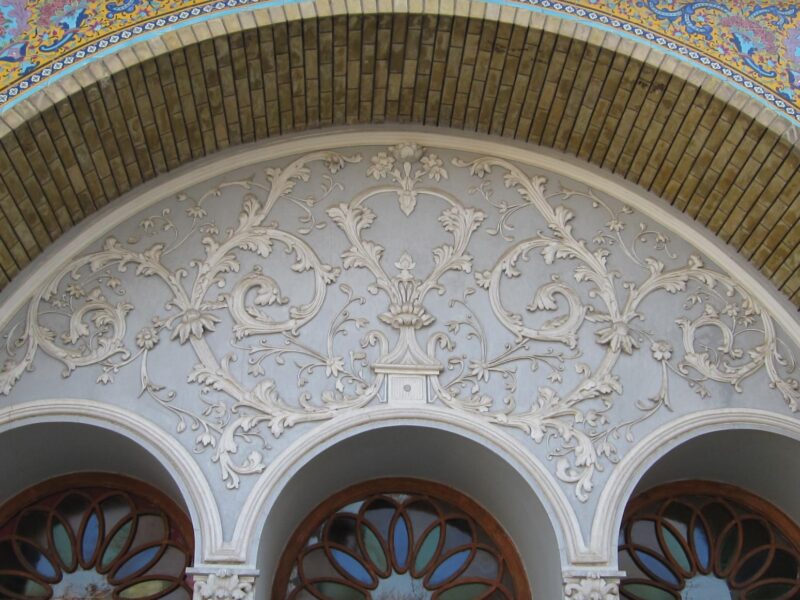
This is where Golestan becomes instantly legible to anyone in the creative industries. It’s a masterclass in commissioning and brand identity, except the “brand” is sovereignty and the “identity system” is tile, mirror, stained glass, carved plaster, painted ceilings, and the kind of spatial sequencing that makes every doorway feel like a cut to a new scene. The famous ayeneh-kari (mirrorwork) turns illumination into choreography. And the jeweled orosi sash windows act like the palace’s color grading suite, editing daylight into rubies and emeralds. If Golestan had a social media manager, the caption would write itself: “natural light, but make it cinematic.”
Golestan’s Qajar era also marks a national obsession with modern media. Photography enters court culture early and enthusiastically, and the palace becomes one of the key reservoirs of that new habit: history, staged, then filed.
In the twentieth century, Golestan’s role shifts again because regimes change, cities grow, and modernity rarely asks permission. Under the Pahlavis (1925–1979), the complex continues as a ceremonial space even as power migrates elsewhere. After 1979, Golestan increasingly becomes what many palaces become when their political job ends: a public heritage site, a museum complex, a place where visitors come not to petition the court but to meet their own past in a room full of mirrors.
And here’s the unglamorous truth behind the glamour: heritage isn’t preserved by vibes. It’s preserved by maintenance. Conservation. Budgets. Training. Policies. Long-term planning. A thousand small, daily acts of care that never trend.
Then came yesterday.
According to UNESCO, the Golestan Palace was reportedly damaged by debris and the shock wave following an airstrike to Arag Square, located in the buffer zone of the site. The damage, as described in arts and local reporting, reads like a checklist of what makes Golestan Golestan: blown out windows, disrupted mirror and glasswork, and impacts to historic orsi and wooden doors. In a complex built to catch and multiply light, “damage to windows and mirrors” isn’t a minor detail, it’s the whole instrument panel.
There’s a painful irony here. Just before the strikes, reports say museum staff and authorities had already begun protective measures: relocating artefacts to safe storage, wrapping chandeliers, doing what museums do when the sky starts sounding like a warning. It’s a scene any registrar or conservator will recognize instantly, minus the palace walls and plus the adrenaline: the sprint to reduce loss, the quiet ritual of packing, the wish that planning can outwit chaos.
And then the international voice arrived.
On 2 March 2026, UNESCO issued a statement expressing concern, saying it is closely monitoring cultural heritage across Iran and the region, and that it has communicated the geographical coordinates of World Heritage and nationally significant sites to parties involved to help avoid damage. It also reiterated the legal frame, naming the 1954 Hague Convention and the 1972 World Heritage Convention. The statement was amplified on UNESCO’s social channels, including X, where the messaging takes on the familiar tone of global guardianship: culture is protected under international law, please do not smash the world’s memory while arguing over the world’s future.
That is the public facing version: heritage as international obligation, heritage as protected category, heritage as “the thing we must not break even when everything else is breaking.”
It is also justifiable to regard this as a performance with selective lighting.
Because war makes heritage damage dramatic and headline-friendly, while the slow violence done to heritage in “peacetime” rarely earns the same urgency, even when it is systemic. Iran’s heritage has been pressured for decades not only by conflict risk, but by development, environmental crisis, and institutional weakness. Sometimes the threat is a missile’s shock wave. Sometimes it is a construction project that creeps too close, an enforcement system that blinks, a budget that vanishes into bureaucracy, or a landscape that quite literally sinks.
Even in the immediate orbit of Golestan, that slow violence is not theoretical. Just months ago, Iranian reporting described disputed construction near the palace and official calls to halt it. Elsewhere, the environmental story has become brutally physical: land subsidence driven by groundwater depletion, cracks and sinkholes, and warnings that major heritage sites like Persepolis face escalating risk as the ground beneath them destabilizes. In other words, Iran’s heritage is being hit from above and eroded from below.
And then there is the ideological layer, the one curators and archaeologists feel in their bones even when nobody prints it on a plaque. Iran’s cultural inheritance is vast, layered, and stubbornly plural. Yet the state’s preferred self-portrait has often leaned on a narrower religious-political framing, leaving pre-Islamic heritage in an awkward position: celebrated as “national prestige” when convenient, underfunded or treated as politically inconvenient when it isn’t. The result is not merely a preservation problem. It’s an identity problem, with scaffolding.
This is where the UNESCO statement can feel thin. Not false, but incomplete. Like a fire alarm that only rings when flames are photogenic.
There’s also a structural reason for that thinness, and it’s worth naming plainly. UNESCO’s World Heritage system is built around member states. It relies on state cooperation, state reporting, and state access. Its strongest levers tend to operate through official channels that can be slow, diplomatic, and often reluctant to sound like direct condemnation when governments themselves are part of the problem. In short: the institution tasked with calling out failures is also designed to keep states at the table. It’s a dance where everyone is holding a very expensive vase and smiling through clenched teeth.
Now add the modern accelerant: the information war.
Very recently, many Iranians have been living through profound trauma and grief amid reports of lethal repression, mass arrests, and communications shutdowns that make reliable verification difficult and isolation more intense. In that atmosphere, heritage damage becomes instantly weaponizable. Online, you can watch the narrative machine spin in real time: people assign blame with absolute certainty, sometimes without evidence, and sometimes with a kind of rhetorical hunger that has little to do with the site itself. The palace becomes a political card. The broken windows become a hashtag battlefield.
What makes this especially bitter, for many, is the asymmetry of outrage. Some voices that never bothered to speak when Iranians were pleading for international attention suddenly discover Iranian heritage the moment it can be used to score geopolitical points. Meanwhile, Iranians inside the country, already exhausted from mourning, are forced to watch a fresh wound turned into content.
This is why I keep returning to accountability as the missing exhibit label.
In my recent post, “ICOM’s Code of Ethics Meets Its Silence in Iran,” I argued that museum ethics cannot be treated like inspirational wallpaper, especially when professionals and communities are trapped inside blackout conditions and credible reports of violence. Codes, charters, conventions, these are claims. The real test is whether institutions uphold their own language when the subject is politically costly. If an organization can speak, and chooses not to, then silence is not neutrality. It is a decision with consequences.
So yes, protect Golestan from missiles. Also protect Iran’s heritage from the slower sabotage of greed, neglect, and politicized “development.” Protect it from enforced isolation. Protect it from the quiet normalizing of damage as the cost of doing business. And, crucially, protect it from being used as a prop while actual people are told to disappear politely offstage.
Which brings us back to Golestan’s broken windows, because they’re more than an incident. They are a metaphor with teeth.
Golestan was built to manage light. It stages illumination. It multiplies it. It turns reflection into authority and beauty into persuasion. Yesterday, those same reflective surfaces are what got hurt first.
Maybe that’s the headline for the creative world: the palace that perfected spectacle has been struck not in its foundations, but in its images, its lenses, its shimmering skins. And once a culture’s ways of seeing are damaged, repair is never only technical. It becomes moral. Political. Human.
If you work in museums, film, design, publishing, preservation, architecture, or any field that trades in memory, Golestan’s shattered glass is not far away. It’s the reminder that heritage protection isn’t a single heroic act after a tragedy. It’s a daily practice. It’s also accountability, not just admiration.
And if there’s a theatrical closing line that Golestan itself might approve of, it’s this: a mirror doesn’t only reflect the world, it reflects what the world is willing to protect. Today, Tehran’s rose garden reflects cracks. What we do next decides whether those cracks become a footnote, or a pattern.