
I last visited Chehel Sotoun in the beginning of 2009, on a road trip with my father and my beloved aunt and uncle. I remember the approach as vividly as the building itself: the measured hush of the garden, the long sheet of water, the columns standing with that Safavid poise that always feels less constructed than conjured. My father, with the patient authority fathers sometimes possess in places they love, explained the name to me. Twenty columns in the portico, forty in the reflection. My aunt laughed at the trick of it, and I remember thinking that the building understood something essential about power and beauty: that both, if they are to last in memory, require a little theatre.
That memory has been difficult to revisit this week.
War has terrible taste. It does not enter a city like a historian, or pause like a conservator, or even pretend to know the difference between a military target and a painted wall. It arrives as a lout with explosives and no respect for what took centuries to survive. In earlier blog posts on Golestan Palace and Tel Aviv’s White City, the first injuries appeared in the skin of architecture: broken glass, damaged façades, the little brutalities done to light. In Isfahan, the violence has moved deeper into the scene. It has stepped onto the terrace.
Chehel Sotoun is not merely a pretty pavilion with a famous pool. It is one of the great Safavid monuments of Isfahan, built in the 17th century under Shah Abbas II as part of the royal complex of a capital that understood architecture as politics, ceremony, diplomacy, and spectacle all at once. This was a reception hall, a place of audiences and state performance, where the choreography of empire unfolded beneath painted ceilings and before visiting dignitaries. Even the building’s name is an act of perception. Twenty wooden columns become forty through reflection in the long pool before them. Its title depends on doubling, illusion, and the elegant deceit of water.
That is part of what makes damage here so especially agonizing. Chehel Sotoun belongs to UNESCO’s Persian Garden inscription, a tradition UNESCO describes as a masterpiece of human creative genius, an earthly image of paradise shaped through water, geometry, shade, architecture, and cultivated air. In this world, the garden is never merely decorative. It is philosophical. It is political. It is an argument about order, climate, pleasure, and civilization. Chehel Sotoun is one of the tradition’s most theatrical statements, a place where authority is staged not by mass alone, but by grace.
Inside, the palace holds some of the most important Safavid wall paintings in Iran: royal receptions, battles, diplomatic scenes, courtly pageantry. This is not mere ornament. It is historical memory painted at architectural scale. A place like Chehel Sotoun does not simply endure history. It stores it.
Which is why the latest reports are so painful, and why they must be handled carefully. On March 10, public reporting indicated that a strike on the nearby governorate building in Isfahan’s historic core caused damage to Chehel Sotoun and parts of the wider Safavid ensemble around it. The clearest accounts describe shattered windows, broken wooden elements, at least one major crack in a historic fresco, and damage to Safavid mirror-work, ayeneh-kari, which was itself recently inscribed on UNESCO’s Representative List of the Intangible Cultural Heritage of Humanity. Officials reportedly said that some of the interior painting may have been spared more extensive destruction.
UNESCO has expressed concern over the protection of cultural heritage in Iran and the wider region, but as of March 11, I have not seen a standalone UNESCO public assessment devoted specifically to Chehel Sotoun. So the honest phrasing is measured phrasing: the damage has been publicly reported and visually documented, but the full official accounting is still trailing behind the blast.
Even that is enough to justify grief.
It hurts all the more because Chehel Sotoun was not abandoned in some forgotten corner when this happened. It had recently undergone restoration work. In 2025, officials announced cleaning and strengthening of the wooden columns, conservation of mirror-work, repairs to tiles and paintings, lighting upgrades, and interventions related to moisture and termite decay. There is something bleakly absurd in that sequence. The columns are cleaned, the mirror-work is tended, the building is carefully readied for another season of admiration, and then war barges in like a drunk critic midway through the performance and mistakes destruction for judgment.
And yet war, hideous as it is, is not the whole story.
Chehel Sotoun stands inside a larger and older contradiction, one that has defined Iranian heritage policy for years. The Islamic Republic does not simply neglect heritage in the passive sense, like a distracted custodian who mislaid the maintenance budget. It profits from heritage, markets heritage, wraps itself in heritage as prestige, and then fails to invest proportionately in the infrastructure needed to protect it. The tragedy is not just destruction. It is extraction.
The state knows perfectly well that monuments are profitable. Last year, Iran’s culture minister said the country earned about $7.4 billion from foreign tourism in the previous Iranian year, with roughly 7.4 million foreign visitors. Isfahan, naturally, is one of the brightest jewels in that economy. In just seventeen days around Nowruz 2024, the province recorded more than 4.6 million visits to museums and historical sites. Heritage in Iran is not some pious abstraction floating above economics. It is ticket revenue, hotel occupancy, restaurant traffic, tour guides, handicraft sales, local employment, urban branding, and hard currency. The state is perfectly happy to drape itself in civilization when civilization is selling briskly.
This is where the corruption becomes visible, even before one utters the word in its narrower and more familiar sense. It lies in the priorities. It lies in the choreography of money. Heritage is celebrated as identity and monetized as atmosphere, while the actual burden of preserving it is too often treated as an afterthought, a ceremonial obligation to be underfunded once the brochures are printed. The palace must charm investors, charm tourists, charm the nation, and charm the world. The upkeep, meanwhile, limps behind like a stagehand ordered to hold up the scenery with one exhausted arm.
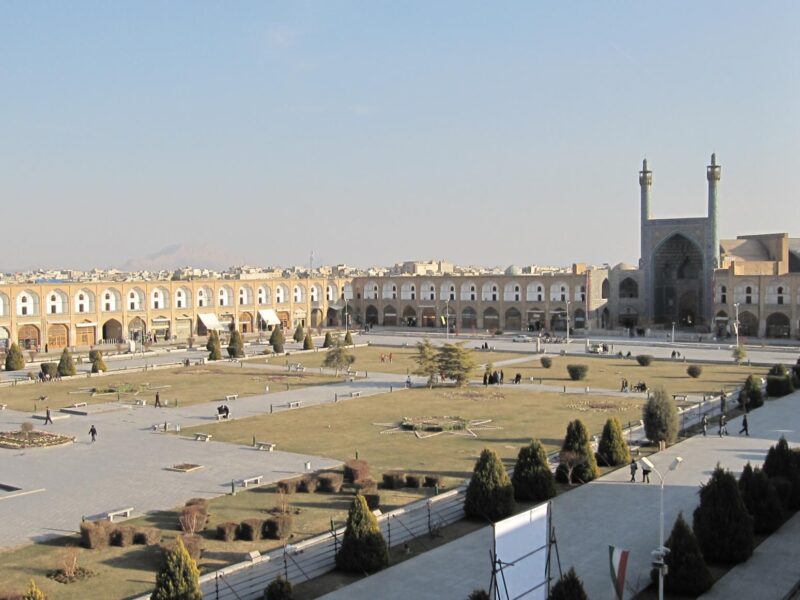
UNESCO itself warns that Meidan Emam, the great Safavid square at the heart of Isfahan, faces pressure from economic development in the historic centre, including plans for multi-storey commercial and parking buildings within the buffer zone. That is not a minor planning inconvenience. It is a philosophy in concrete. History is treasured most lavishly when it can be packaged, photographed, sold, and draped over an investment prospectus. The moment it slows a project, complicates a permit, or demands expensive restraint, it becomes negotiable.
The naming matters here too. The historic name of Meidan Emam was Naqsh-e Jahan Meidan, the “Image of the World” Square, from its construction between 1598 and 1629 until the 1979 Islamic Revolution. Even in nomenclature, history has had to survive revision.
Recent investment language out of Isfahan makes the imbalance almost embarrassingly plain. Officials and investment materials have promoted tourism projects in aggressively commercial terms, boasting around 110 ready-to-build investment packages and advertising that the municipality covers 99 percent of hotel construction permit fees. Elsewhere, provincial officials have celebrated nearly 200 tourism, accommodation, and hospitality projects underway, valued in the hundreds of trillions of rials. Development is not inherently the enemy of heritage. A living city must continue to live. But when hospitality is subsidized by IRGC or government-related entities, investment is fast-tracked, and historic districts are mined for value while the monuments themselves remain vulnerable to chronic under-maintenance and recurrent danger, the message is difficult to miss. The city is profitable enough to package, but not precious enough to protect.
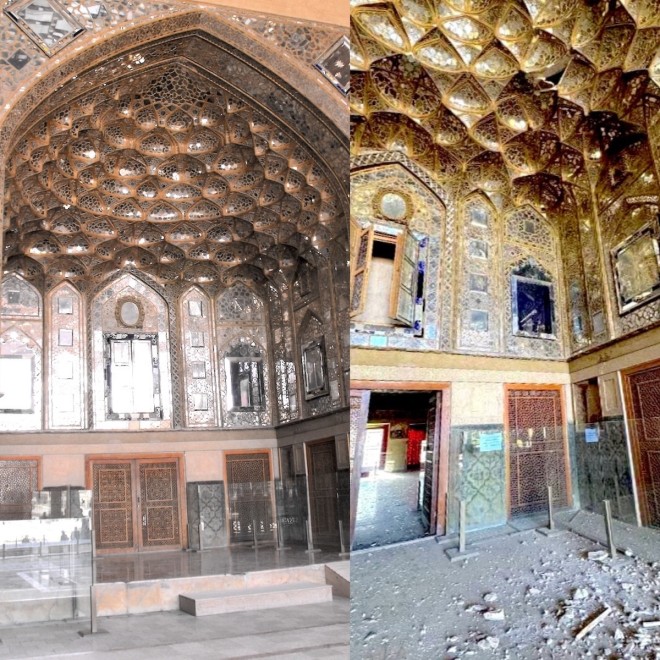
That is the atmosphere in which Chehel Sotoun was damaged. Not an oasis of pure care shattered by sudden war, but a place already caught between reverence and revenue, between public memory and voracious commercial appetite, between the language of civilization and the arithmetic of corruption, subsidies, and permits. War did not invent that contradiction. It merely tore the curtain down in the middle of the act.
For me, that is what makes this loss feel so intimate. I cannot think of Chehel Sotoun only as a UNESCO site, or only as a Safavid masterpiece, though it is both. I think too of that morning in 2008, of my father explaining the reflected columns, of my aunt delighting in the sly visual joke of the place, of the strange serenity the building seemed to produce simply by standing there. Chehel Sotoun always had wit. It knew how to make grandeur look effortless. It knew how to turn architecture into a soft, persuasive kind of astonishment.
Now it has been made to absorb the ugliest kind of modern bluntness.
Additionally, and particularly, I have had no communication with my father or my aunt, in fact with the rest of my family, since the start of the Iran War eleven days ago. Put simply, I do not know whether they are dead or alive.
A wounded monument is not a lost one. Chehel Sotoun still stands. Its pool still reflects. Its columns still hold. That matters. But what has been injured here is larger than wood, plaster, glass, and mirror-work. It is a sentence in the architecture of Iran, written in water, shade, paint, and symmetry. When such a sentence is struck, the question is no longer only what war destroys. It is also what the state has been doing, year after year, while living off the beauty it has failed to guard.
Tomorrow’s post belongs to that ledger.
SOURCES:
The Art Newspaper: damage to Chehel Sotoun and nearby Safavid-era sites, March 10, 2026
UNESCO: concern over protection of cultural heritage sites amid escalating violence
UNESCO World Heritage: The Persian Garden
Tehran Times: Chehel Sotoun restoration work
Tehran Times: Iran tourism revenue figures
Tehran Times: Nowruz visitor numbers in Isfahan