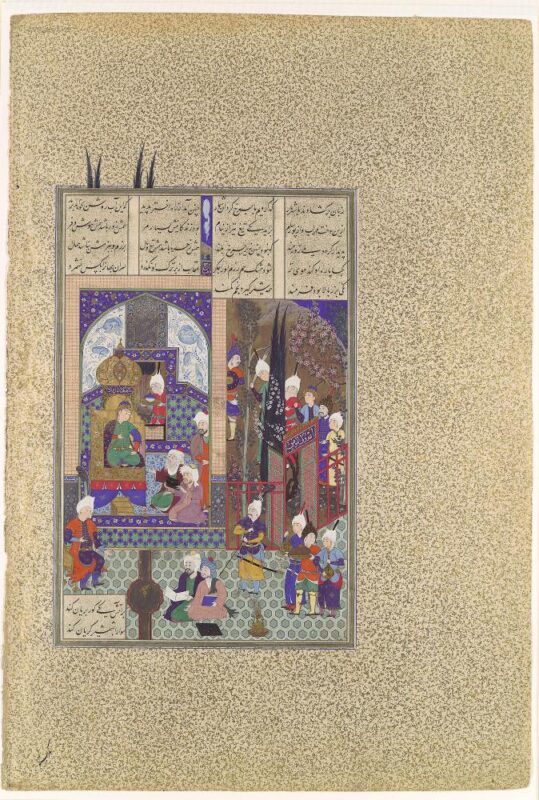
UNESCO celebrates the ancient spring festival as a triumph of shared humanity. It is less eager to say, plainly, that Nowruz is Persian in name, Iranian in cradle, and one of the great survivals of the pre-Islamic Iranian world.
The Vanishing Birth Certificate
UNESCO has a refined talent for handling ancient inheritances: praise them lavishly, scatter them across a map, and quietly misplace their birth certificate. Its treatment of Nowruz is a beautiful example of the form. On Instagram, UNESCO declares that “in times of uncertainty, the spirit of Nowruz reminds us of the importance of hope, dialogue, solidarity and respect for our shared humanity.” Around 21 March, it says, many communities welcome spring through traditions tied to nature, renewal, the equinox, fire, water, music, dance, games, and family gatherings. All of this is pleasant, true, and upholstered in the soothing fabric of international cultural diplomacy. Yet the prose glides around the central fact with suspicious grace: Nowruz is an ancient Iranian feast.
UNESCO does mention Iran. It simply does so the way a nervous awards committee mentions the star while giving the close-up to the ensemble. On its official International Day of Nowruz page, Iran appears as one state among many in a joint inscription. The holiday is presented as a shared civilizational treasure stretching across the Balkans, the Black Sea Basin, the Caucasus, Central Asia, the Middle East, and beyond. UNESCO emphasizes peace, solidarity, reconciliation, and neighborliness. It does not plainly say that the feast’s deepest roots are Iranian, that its very name is Persian, or that its oldest religious horizon lies in the world of ancient Iranian and Zoroastrian tradition. The effect is oddly theatrical: the curtain rises, the orchestra swells, the audience is told to admire the splendor of the palace, and no one is permitted to ask who built it.
Origins Without a Name
The oddity sharpens when one follows UNESCO to the United Nations resolution it cites. The General Assembly’s 2010 resolution recognizing the International Day of Nowruz is respectful, ceremonious, and almost acrobatically evasive. It notes that the holiday has been celebrated for more than three thousand years, links it to renewal in nature, and invites member states to study its origins and traditions. Yet nowhere does the resolution name Iran or Persia as the historical source. Origins, apparently, are welcome to hover nearby like tasteful ghosts, provided they do not insist on an introduction.
This is especially strange because UNESCO itself has elsewhere managed to remember the obvious. In a 2018 article later updated in 2023, it referred to Nowruz as the New Year of peoples once part of the Persian Empire and explicitly described Iran as “the centre of ancient Persia.” So the institution is not incapable of historical memory. It is merely selective in its use.
Why the hesitation? Part of the answer is institutional style. UNESCO prefers a shared table to an argument over first authorship. Once a tradition is practiced across many modern states, it is repackaged as transnational, communal, jointly safeguarded. None of this is false. Nowruz does belong, today, to many peoples across a vast cultural world. But diffusion is not the same thing as origin. A river that waters twelve countries still has a source. The multinational framing becomes misleading when it treats genealogy as bad manners.
The Regime and the Feast It Could Not Kill
Then there is the darker comedy of modern politics. Since the 1979 revolution, the Islamic Republic has had an uneasy, sometimes openly hostile, relationship with Iran’s pre-Islamic heritage. Iranian leaders and clerics have tried to discourage traditional Nowruz observance because of its non-Islamic, Zoroastrian roots, even as ordinary Iranians continued to celebrate it with the obstinacy of people defending not just a holiday but a civilizational memory.
Efforts to diminish the feast largely failed. The state adjusted. It now issues annual public Nowruz messages because one can only glare at a 7,000-year-old tradition for so long before realizing the tradition will almost certainly outlive the glare. That does not prove UNESCO omits Iran because Tehran demanded it. The evidence does not support such a tidy arrangement. But the irony is still exquisite: a global cultural institution and an Islamic revolutionary state, for different reasons, arrive at the same useful blur.
The Ancient Iranian Core
That blur matters because Nowruz is not merely spring cheer with better table settings. It is one of the great survivals of the Iranian world. The word itself is Persian: now, new; ruz, day. Its calendar is not arbitrary. The Iranian year begins at the vernal equinox, when time is synchronized with the sky rather than merely announced by administrative habit. That gives the feast a grandeur many modern New Year rituals can only dream of. Nowruz is astronomy turned ceremonial, cosmology carried into the home.
Its deepest roots lie in ancient Iranian tradition and in the religious world of Zoroastrianism, though like all durable inheritances it long ago overflowed any single doctrinal frame. Encyclopaedia Iranica describes it as the holiest and most joyful festival of the Zoroastrian year. Britannica traces it to ancient Zoroastrian religion and notes that it later became a broadly shared, often secular New Year festival across societies shaped by Persian culture. That double life is part of its genius. Nowruz is at once sacred and domestic, metaphysical and practical. It survives dynasties because it lives in households.
Myth, Empire, Survival
Legend, naturally, dressed it in royal light. In Persian tradition, especially through the Shahnameh, the feast is bound to Jamshid, the radiant king whose enthronement marks a new beginning for the world. Myth is not a notarized record, but it reveals what a civilization believed the holiday meant. In this case, it meant the triumph of light over darkness, order over desolation, vitality over winter’s long and miserable sulk. Nowruz arrived not as a calendar square but as drama.
As Iranian civilization developed its imperial forms, that drama acquired ceremonial weight. Nowruz entered courts and state ritual. It became a season in which sovereignty could be displayed and the renewal of the year could echo the renewal of order. Later conquests and religious changes did not extinguish it. After the Islamic conquest, many Iranian traditions tied specifically to pre-Islamic ideology and Zoroastrian ritual weakened or vanished. Nowruz did not. As Encyclopaedia Iranica notes, it survived because it was so deeply embedded in Iranian tradition, history, and cultural memory that Iranian identity and Nowruz “mutually buttressed each other.” Few phrases capture civilizational endurance more elegantly.
The Table as Worldview
That endurance is visible in the modern Nowruz table, which is never merely decorative. The haft-sin is a compact theater of meaning: green shoots for rebirth, apples for beauty, garlic for protection, vinegar for patience, sumac for the color of dawn, and other symbolic items gathered with mirrors, candles, poetry, coins, painted eggs, sacred text, and memory. The table is not a prop. It is a worldview in miniature. It says the home can be reordered, the year renewed, the dead remembered, and poetry seated beside prayer without asking permission from ideology.
Which is why the language of soft erasure feels so graceless. To say that Nowruz is celebrated in Tajikistan, Uzbekistan, Afghanistan, Iraq, Azerbaijan, Türkiye, India, Pakistan, the Caucasus, Central Asia, the Balkans, and diasporic communities worldwide is correct. To say it now belongs to many peoples is also correct. To call it shared living heritage is perfectly fair. But none of this requires historical anesthesia. A shared feast can still have a birthplace. A tradition can travel without becoming parentless.
A Feast Too Stubborn to Be Abstracted
UNESCO’s own archive quietly proves the point. In that 2018 article, it identified Iran as the center of ancient Persia, described Iranian preparations, and discussed the haft-sin in specifically Iranian terms. So the institution already knows that acknowledging origin does not diminish plurality. It clarifies it. The splendor of Nowruz lies not in pretending it came from everywhere, but in recognizing that something born in the Iranian world became spacious enough to be cherished far beyond it.
That may be what unsettles both bureaucracies and ideologues. Nowruz resists confiscation. The Islamic Republic could not successfully strip it of its pre-Islamic resonance. UNESCO cannot quite dissolve it into a frictionless global abstraction. The feast keeps returning with the equinox, carrying green shoots, fire rituals, old poems, and the faintly indecent insistence that history happened somewhere specific.
So let us say the plain thing without panic or perfume. Nowruz is a shared festival with ancient Iranian roots. It is Persian in name, Iranian in cradle, Zoroastrian in deep ancestry, and gloriously expansive in its later life. It belongs today to many communities across many countries. But it did not emerge from an airport lounge called “the region.” It came from somewhere. UNESCO should be able to say so. In fact, it already has. The problem is that it says it in one room and forgets it in another.