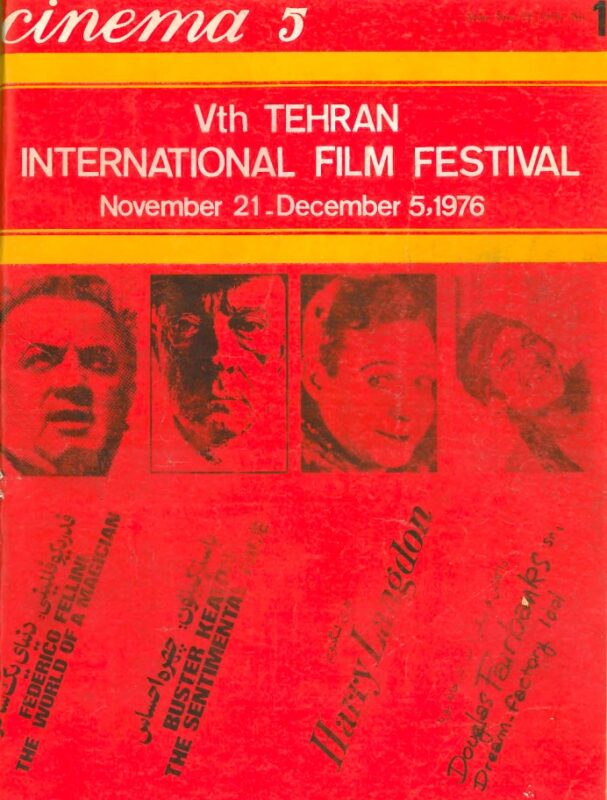
I find myself thinking of the Tehran International Film Festival, founded in 1972 and gone by 1977 after only six editions, but incandescent while it lasted. It belonged to that larger moment when Iranian cinema was moving toward formal ambition and public seriousness, in step with the Iranian New Wave and a wider culture of film journals, festivals, debate, and experiment. This was not a Tehran waiting to be civilized from abroad like some anxious provincial at the embassy door. It thought of itself, with reason, as a city capable of hosting modernity in Persian. The festival itself had appetite from the start. Bahram Beyzaie’s Downpour won a special jury prize at the first edition in 1972, an important showcase for New Wave cinema. In 1974, Beyzaie’s Stranger and the Fog was praised for technical achievement even as critics recoiled from its mythic, non-realist ambition. In 1976, Mohammad Reza Aslani’s Chess of the Wind premiered at the fifth festival, only to be sabotaged by a reel-order fiasco, dim projection, and a hostile press encounter that helped bury one of Iranian cinema’s boldest works for decades. Tehran, in those years, knew how to stage triumph. It also knew how to stage catastrophe with unnerving panache.
By that fifth edition, the festival had grown almost imperially confident. The 1976 catalogue places Iranian cinema alongside works from across Asia, while also offering retrospectives on Langdon, Buster Keaton, and Douglas Fairbanks Sr., an “American Self-Portrait” panorama, a survey of feature-length documentaries, and a “Festival of Festivals.” Then the catalogue itself enters like a grand actor who knows exactly where the light is: Omar Khayyam, a Persian definition of the magic lantern, and that splendid salutation, “Welcome, Honoured Guest.” Before a single frame flickers, the thing has already declared its character: ceremonious, worldly, enchanted, and entirely certain that modernity need not arrive barefoot and amnesiac. Reading it now, I do not hear administration. I hear Iran in full performance mode, equal parts impresario and diplomat, determined to place Tehran not at the margins of world cinema but at its glittering center. That is what gives these pages their sting. They are not a collector’s trinket from a lost belle époque. They are evidence of an Iran that knew how to imagine itself in public, lavishly, intelligently, theatrically, and to treat culture as civic language rather than decorative garnish. The Islamic Republic has spent nearly half a century trying to bully that language into submission. Now war, brought about by that genocidal regime, threatens to do its own editing with fire.
“For in and out, about, below,
’Tis nothing but a Magic Shadow-Show,
Play’d in a box whose Candle is the Sun,
Round which we Phantom Figures come
and go.”
—Edward Fitzgerald’s
rendition of Omar Khayyam
“The Magic Lantern is a lantern on
which figures are drawn, and those figures
rotate around the fire of the lamp.”
— definition from the Borhan-e Qate’,
a fourteenth-century Persian dictionary
WELCOME,
HONOURED GUEST
Lotf kardid: (“You did grace.”) —
which is a proper Persian way of saying,
“How kind of you to come!”
We’re moving ahead, and we’re glad to have you on the bandwagon. This year we’re celebrating an ancient tradition and a recent one all in one breath. We’ve managed so far to keep the inner spirit of our tradition by having the resiliency of being able to keep it ‘up to date’. This year’s fiftieth anniversary of the film industry under the Pahlavi Dynasty is a celebration of both the continuity of the content and the ‘modernity’ of the form. In honour of this, we present a retrospective of our film industry over the past half-century as part of our festivities this year, in order to show our attempts at applying the new art form in the context of our age-old artistic tradition.
At the same time we’re moving forward into the realm of new aesthetic perspectives by bringing the spirit of an experience which produced some of the world’s finest poetry, painting and philosophical expressions, together with the technology of a new genre. The cinematic medium has been in Iran since the time its material first became popularly available.
We have lit another “Magic Lantern” to illuminate our cultural horizon, to forge a cinema which expresses the richness of the inner life, the dilemma of man in the universe and the tactile things of everyday life.
Besides the panorama of Iranian film-making, showing our side of the picture, we are pleased to present the works of other Asians, looking towards the rising sun of the Oriental Horizon. While the film makers of this continent are ironically part of a ‘New World’ of adaptation and experimentation, three retrospective programmes in the fifth festival provide a look at foundational developments in the ‘Old World’ of America. Langdon and Keaton set a high standard for comedy in the early days, while Douglas Fairbanks Sr., opened the magician’s bag of cinematic tricks and special effects. The American Self-Portrait panorama presents films from different periods of that country’s all-important contribution to the art, arranged in such a way as to provide an insight on how cinema can reveal the sociology of its people.
In addition, a look at the non story-telling potential of the medium broadens the perspective still further, with a review of recent achievements in the feature-length documentary, where the Eyes and Ears have it. And, in sum, the Festival of Festivals stresses the overall excellence attained over the past year.
We’ve been moving into new territory in festival settings. Five years ago, we brought the festival idea into the world of the big city. Festivals in the past had always been in spas, gracious towns with small populations and smart resort facilities, available to the professional few and the elite of well-to-do aficionados.
We thought it might be appropriate to bring the people into the purview of the festival, to participate in the percolating excitement of a medium in the process of displaying the full vigour of its possibilities before the public eye. What better place, we thought, than the nation’s capital, providing access for both international travellers and the largest segment of the quality film viewing community.
But now we’re moving out. For, as we grew, so did Tehran — like Topsy. The problems of traffic and construction are abundantly evident. Their sholugh is a test of our own traditional lotf. The city has experienced a five-year increase of two hundred per cent in the number of vehicles, reaching the present point of some two million. When we would like to bow our honoured guest gracefully ahead through the door, we may be blasted by an Iran National truck, beeped by a Peykan car or piped at by the aggravated driver of a diminutive Jiyan. So we’re getting out.
We’re moving on to Isfahan next year, and rediscovering our past into the bargain. It’s still a big city, with a sophisticated population. But it has less congestion and more time and space for contemplation of structures which reflect the eternal verities.
Cinema 5, Vth Tehran International Film Festival, November 21 – December 5, 1976