Last night, Oscar night performed its usual sleight of hand: a blizzard of glamour, a few victors, a few bruised egos, and the annual miracle by which moral vanity arrives in couture.
We watched Hollywood “royalty,” and their descendants, swaddled in enough satin to upholster a minor monarchy, complete with queens, tiaras, and princesses who often deride Iranian constitutional monarchists, rise in standing ovation for a white-saviour multimillionaire, Javier Bardem, delivering his “No to War, Free Palestine” speech. This from the same Hollywood “royalty” that earlier this year, less than five weeks ago, found no urgency, no cameras, no trembling conscience, when tens of thousands of Iranians were being beaten, abducted, illegally jailed, raped, tortured, and slaughtered by the Islamic Republic. For reference, see my piece, Selective Conscience: Why Cultural Institutions Won’t Say Iran.
These same “human rights” activists, who failed to stand up for Israeli women after the atrocities of October 7, never seem to tire of chanting “Free Palestine.” Free from what, and from whom, exactly? From Jews? That is not some harmless bit of festival-season poetry. It is, in effect, a chant for the destruction of seven million Jews living in Israel. And now, as if by divine casting call, these same artists have suddenly discovered their voices, only to raise them against the demise of the genocidal Islamic Republic. The same “spiritual” activists who sneer at Christians for praying in public, whether in schools or in the Oval Office, are perfectly willing to defend the preservation of a regime whose leader invokes not Mojtaba Khamenei, but Imam Mahdi, in occultation since 874 AD. Apparently public prayer is vulgar, unless attached to a theocracy with prison cells.
But this year, the cut from Hollywood to Tehran is not a graceful dissolve. It is a jump cut, with debris still in the frame.
I write this as an Iranian with family still in the country, watching bombs fall on a homeland already exhausted by grief. I have no interest in the dainty etiquette that insists one must choose between condemning war and condemning the Islamic Republic. I can do two things at once. The regime is a machinery of repression, execution, censorship, and regional havoc, and it should go. I loathe wars. I lived through the Iran-Iraq War, on the Iranian side, for three and a half years. It was horrific. A bomb is never abstract for long. Very often it lands on someone’s aunt, someone’s child, someone’s window, someone’s ordinary Tuesday. Or someone’s father. Mine, perhaps. I have had no news of him since February 28, because the Iranian regime has once again committed its familiar species of human-rights crime by cutting off the internet.
That distinction matters. Wanting the demise of one of the most sadistic criminal regimes of the late modern era, a regime that happens to occupy one’s motherland, is not the same thing as cheering war. Propaganda, like bad theatre, is forever overselling its own heroism. The Islamic Republic has spent decades behaving like an arsonist appointed chief conservator of the national archive. It has brutalized Iranians, exported violence, and tried to shrink a civilization into an ideology narrow enough to fit inside a slogan and a prison cell. I have no wish to perfume that record.
Which is why the presence of actual Iranian filmmakers at the ceremony mattered far more than the preening sermonettes around them. Mohammadreza Eyni and Sara Khaki were there as nominees for their documentary Cutting Through Rocks, and Jafar Panahi was there too, carrying with him the moral and artistic weight of decades. Eyni and Khaki did not arrive as decorative Persians for the western conscience to pat on the head. They came as filmmakers whose work emerges from Iranian reality rather than from imported slogans. Reuters then managed the small but revealing scandal of mistranslating Eyni’s remarks: he was speaking about internet access in Iran and about hope, even amid war, because many Iranians see this moment as a chance for the regime’s fall. Even when Iranians are allowed into the room, someone still rushes to rewrite their lines. Panahi, meanwhile, hardly needs introduction. For years he has stood as one of the most fearless figures in Iranian cinema: censored, banned, detained, and yet somehow still making films with the calm insolence of a man who knows tyranny is, among other things, aesthetically vulgar. His career, from The White Balloon to Offside, This Is Not a Film, Taxi, and beyond, has been a running rebuke to the state’s efforts to suffocate imagination. If Hollywood wished to hear from Iran, Iran was right there on the carpet. It simply preferred the ventriloquists.
And Iran, let it be said, is no stranger to the Academy. Iranian filmmakers and Iranian-born artists have been knocking on that gilded door for decades, and sometimes kicking it open. Majid Majidi’s Children of Heaven announced Iranian cinema to the Oscar stage with quiet radiance. Asghar Farhadi went further, winning twice and proving that Iranian cinema did not need pity, translation into moral baby talk, or western certification of its seriousness. Shohreh Aghdashloo’s nomination made history of another kind. Across international feature, acting, documentary, and short-form work, the record is now substantial enough to make last night’s selective empathy feel even more grotesque. Iran is not some suddenly visible tragedy because the Oscars briefly tilted their spotlight eastward. Iranian artists have long been part of world cinema’s bloodstream. The insult is not that they are absent. The insult is that they are noticed only when they can be made to serve someone else’s slogan.
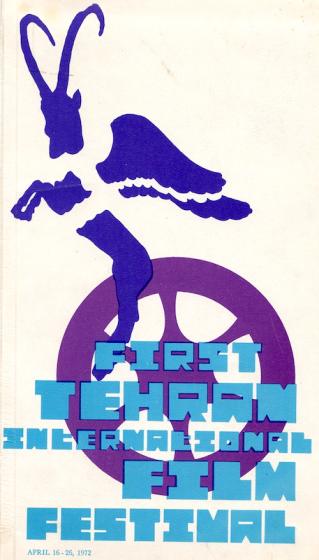
Which is precisely why I want to turn toward another cinematic stage: the Tehran International Film Festival, founded in 1972 and gone by 1977 after only six editions, but incandescent in those brief years. It belonged to a larger moment in which Iranian cinema was surging toward formal ambition and public seriousness, in step with the Iranian New Wave and with a wider culture of film journals, festivals, debate, and artistic experimentation. This was not a timid little showcase nervously adjusting its cuffs. Bahram Beyzaie’s Downpour won a special jury prize at the first festival in 1972, an important showcase for New Wave cinema. In 1974, Beyzaie’s Stranger and the Fog screened there and divided critics with exactly the kind of glorious trouble real cinema ought to cause. In 1976, Mohammad Reza Aslani’s Chess of the Wind premiered at the fifth festival, where a reel-order fiasco, dim projection, and a hostile press encounter helped send one of Iranian cinema’s boldest works into decades of oblivion. Tehran, in those years, knew how to stage triumph. It also knew how to stage catastrophe with unnerving flair.
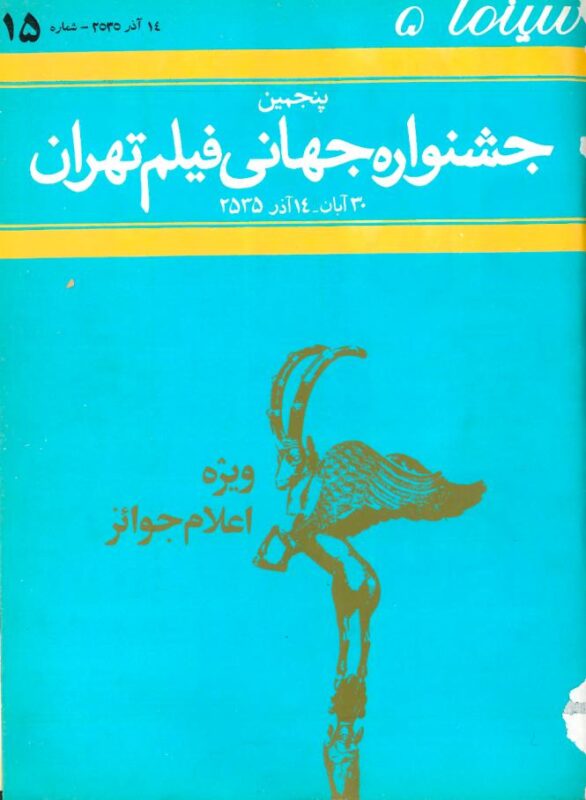
By the fifth edition, the festival had grown positively imperial in range. The 1976 catalogue places Iranian cinema beside works from across Asia, while also mounting retrospectives devoted to Harry Langdon, Buster Keaton, and Douglas Fairbanks Sr., an “American Self-Portrait” panorama, a survey of feature-length documentaries, and a “Festival of Festivals.” It does not shuffle in carrying a clipboard. It sweeps onstage. Omar Khayyam appears. A Persian definition of the magic lantern appears. Then comes that splendid salutation, “Welcome, Honoured Guest,” as if the curtains have parted and the orchestra has struck its first note. Before a single frame flickers, the festival has already announced its character: ceremonious, worldly, enchanted with cinema, and perfectly certain that modernity need not arrive barefoot, stripped of memory, at the door.
Reading it now, I do not hear the dry hum of administration. I hear Iran in full performance mode, equal parts impresario and diplomat, determined to make Tehran feel not peripheral to world cinema but gloriously central to it. That is the pleasure of these pages for me, and also their sting. I read them while Tehran is once again illuminated under fire, thanks to its own barbaric regime, a regime with no interest in art, while cultural sites cannot be spared the concussion of war.
So no, I am not reading this brochure as a collector’s bauble from some lost belle époque. I am reading it as evidence. Evidence of an Iran that knew how to imagine itself in public, lavishly, intelligently, theatrically; an Iran that understood culture as civic language rather than decorative garnish. The Islamic Republic has spent nearly half a century trying to bully that language into submission. War, brought about by that genocidal regime, now threatens to do its own editing with fire. But Iran is larger than the regime that has disgraced it, and larger too than the bombs now pretending to rearrange its fate. Under such conditions, a festival catalogue ceases to be ephemera. It becomes a small, stubborn proscenium of memory.
And memory, thank heaven, is harder to bomb than a building.