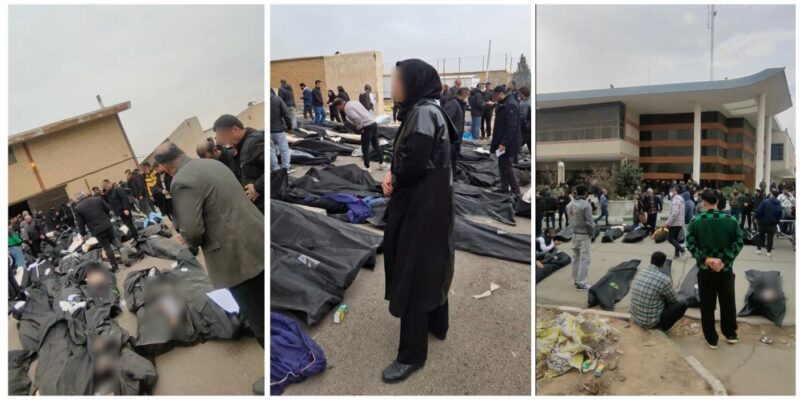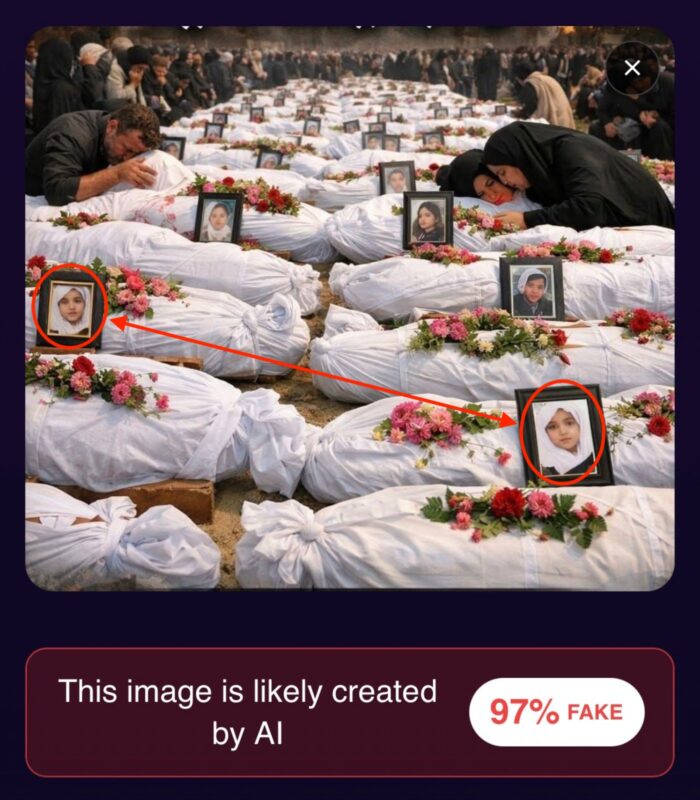
There is a particular kind of moral vandalism that only our era could mass-produce: dressing a claim in a photograph, then discovering the photograph was never a photograph at all. Not a document. Not a witness. A costume. A synthetic shroud stitched together by prompts and pixels, then paraded through a timeline as if it were evidence.
As an Iranian-born American woman who is trained as a cultural historian with deep concerns about Human Rights in Iran, I cannot treat this as mere “online drama.” In many cultures, including Iranian culture, the dead are not content. The dead are the last remaining citizens when a state has stripped the living of citizenship. The body, the burial, the mourning rites, the forty-day ceremony, these are not decorative customs. They are a people’s last jurisdiction when courts are theater and prisons are factories. When AI imagery is used to depict Iranian children in body bags and those images are circulated as political ammunition, something fundamental breaks: the dignity of the dead, the integrity of information, and the moral credibility of the people who claim to defend rights.
The modern information ecosystem is already at war with truth. The UN Secretary-General has warned that mis- and disinformation, amplified at industrial scale, threatens “information integrity” and corrodes public trust, governance, and human dignity. UNESCO has described the “crisis of knowing” that synthetic media intensifies, where the very suspicion of fabrication becomes a weapon, because it makes reality negotiable. And the technology is no longer niche. Conflict zones have already become laboratories for AI-driven propaganda, from synthetic “evidence” to emotionally engineered imagery designed to mobilize outrage faster than verification can breathe.
This is why the phrase used by Francesca Albanese is a UN Special Rapporteur: “the picture is not the issue” is so chilling when deployed as a defense. Because the picture is precisely the issue when the picture is being used as a carrier for moral authority. The image is not a garnish. It is a claim of proximity. A photograph says: I was there, or someone was there, and here is what happened. When the “photograph” is AI-generated, that proximity is forged. And in human rights work, forged proximity is not a harmless shortcut. It is a contamination event.
There is also the child. The Convention on the Rights of the Child is built on an insistence that children are owed special protection, dignity, and care. UNICEF’s own ethical imagery guidance stresses that images of children are not interchangeable symbols, they demand heightened restraint, context, and protection. Even when images are real, international humanitarian and human rights law wrestle with the dignity of the dead and the limits of public curiosity. So what do we call it when the child is not even real, but the grief is made to look real, and the audience is instructed to feel morally summoned by a fabrication?
Let’s be blunt: synthetic images of dead children are not “awareness.” They are theater. And in wartime, theater has consequences. A fabricated image can incite, inflame, and harden public opinion. It can also backfire in the most poisonous way: once exposed, it becomes a solvent that dissolves attention from real victims. The lie does not merely mislead, it teaches the audience to stop believing. The most cynical actors understand this perfectly. If you can flood the zone with images that might be fake, you can make authentic atrocity footage seem suspect by association. Confusion becomes a tactic, and the victims pay twice, once in blood, once in disbelief.
This matters acutely for Iran because the Islamic Republic has spent decades weaponizing death and policing grief. The UN Independent International Fact-Finding Mission on Iran documented serious violations tied to the 2022 “Woman, Life, Freedom” protests, including unlawful killings, torture, and sexual violence, and highlighted entrenched impunity. Amnesty International has detailed rape and other sexual violence by intelligence and security forces against detainees from that uprising, with judicial authorities complicit through cover-up and inaction. More recently, major human rights organizations have reported mass arrests, torture, enforced disappearances, and a suffocating clampdown after the latest waves of protest and massacre, paired with measures to silence families and conceal crimes.
The official numbers for this atrocity varies: Iran’s own government claims some 3,000 Iranians murdered. Outside Iran, Iranians and other officials and publications allege 32,000+ victims. INSIDE Iran, activists have claimed upward of 90,000 protestors have been slaughtered by the Islamic Republic since the start of 2026.
And then there is mourning, the cultural nerve the regime repeatedly tries to sever. NPR has reported Iranian authorities cracking down on families attempting to hold the forty-day mourning rituals, a profound rite in Iranian culture that often becomes a rallying point for collective memory and resistance. Other reporting has described pressure on families around burials, release of bodies, and the state’s effort to turn funerals into controlled events, or to prevent them altogether. These are not side notes. In Iran, the funeral is frequently the last free parliament. That is why the regime fears it.
There is also a long, dark continuity: Iran’s history of hidden burial sites and mass graves is not speculative folklore. Amnesty International and Justice for Iran have documented the deliberate destruction and concealment of mass grave sites tied to the 1988 prison executions of estimated 30,000+ prisoners of conscious, including harassment of families and disruption of memorial practices. When today’s activists warn about secrecy around bodies, rushed burials, intimidation, and the erasure of evidence, they are speaking into a historical echo chamber built by the state itself.
Against this backdrop, the ethical failure of circulating AI-generated “proof” is not just that it may be false. It is that it mimics, and therefore trivializes, the exact mechanisms of coercion and concealment that Iranians have been fighting for decades. The Islamic Republic has tried to control who is seen, who is mourned, who is counted. AI “atrocity images” do something grotesquely adjacent: they manufacture the seen, the mourned, the counted, without the consent of reality.
Now to the question of platform influence and professional responsibility. The three figures, though there are too many to mention, at the center of this episode are not anonymous accounts shouting into the void. Francesca Albanese (UN Special Rapporteur) is publicly described by OHCHR as an international lawyer specialized in human rights and the Middle East. William Dalrymple is a celebrated historian with a global readership and institutional prestige. Bruno Maçães is a prominent political writer and a foreign correspondent for the New Statesman.
These credentials are not decorative titles. They are a promise of method: care with sources, respect for evidence, and the humility to correct the record.
When public figures with that kind of reach circulate imagery that independent observers flag as AI-generated, the damage is multiplied. First, it launders synthetic content through the authority of respected institutions and careers. Second, it rewards a politics of emotional certainty over evidentiary discipline. Third, it teaches the public that “human rights” is a costume one can put on when convenient, a language to deploy when it flatters a geopolitical story, then fold away when the victims are inconvenient, like the tens of thousands of Iranians brutalized, detained, tortured, sexually assaulted, disappeared, and executed over years of repression.
This is where propaganda enters through the side door labeled “compassion.” A fabricated image of Iranian children in body bags can be weaponized as anti-American and anti-Israel rhetoric precisely because it is maximally inflammable and minimally accountable. It is grief without chain-of-custody. It is moral rage without verification. And it is often paired with a studied silence about the regime’s own violence against Iranians, including the cultural violence of denying families the right to mourn.
To be clear: none of this requires anyone to deny the suffering of civilians, anywhere. In fact, it requires the opposite. It requires us to insist that civilian suffering is too important to be illustrated with fiction. The Financial Times recently documented how AI-manipulated imagery, presented as if it were genuine satellite evidence, can ricochet through public discourse in minutes, demanding policy conclusions before truth can catch up. That is exactly why international norms are moving toward transparency obligations for synthetic media, including labeling and marking AI-generated content. The point is not to scold technology. The point is to preserve the evidentiary floor beneath human rights advocacy, so it does not collapse into spectacle.
So what should be demanded, culturally and institutionally, from high-profile advocates and commentators?
First, a simple rule that should not be controversial: do not use AI-generated images to depict real-world victims or alleged casualties in an ongoing conflict. Ever. If you need an image, use verified photojournalism, or do not use an image at all.
Second, adopt a “correction protocol” with teeth. If you posted synthetic or unverified atrocity imagery, you do not get to “double down” with vibes. You remove it, you correct it, you explain it, and you do it loudly, with the same reach as the original post. Information integrity is not restored by quiet edits.
Third, treat culture as evidence. If you claim to care about Iranian human rights, speak about Iranian human rights when no Western narrative benefit is attached. Speak when the regime kills protesters. Speak when families are threatened for mourning. Speak when sexual violence is used as punishment. Speak when the internet is cut to hide massacres. Anything less turns “human rights” into a rented tuxedo, worn for a photo, then returned before the bill arrives.
Finally, a note on credibility. It it is not unreasonable for the public to ask: if you are careless with evidence in front of millions, what are your standards when fewer eyes are watching? The burden is not on the audience to keep trusting. The burden is on the authority figure to keep earning trust.
Iran’s dead do not need to be invented. The Islamic Republic has supplied enough reality for a century. What Iranians deserve is not synthetic pity timed to foreign policy cycles. They deserve solidarity grounded in truth, and truth grounded in discipline. If we cannot protect even that, then the body bag becomes more than an image. It becomes a metaphor for what we have done to reality itself: sealed it up, tagged it with a slogan, and called it justice.
One last request, offered with solemnity: if you want to speak for the dead, do not impersonate them.